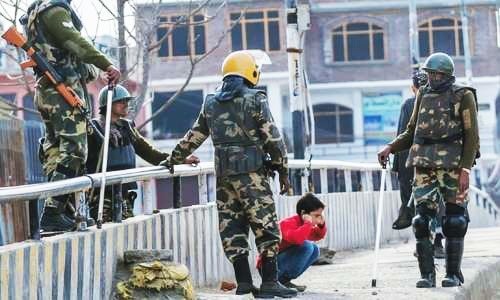
WASHINGTON: “Teen girls with stones are the new threat in India’s Kashmir conflict,” says The Washington Post in a news story that reviews the current situation in the valley.
“As India’s most restive region stares down the abyss of what a commentator calls another “hot summer of violence”, the doom-laden headline has returned with a vengeance: “Is India losing Kashmir?” asks a BBC article.
“Anti-government protests have escalated again in Indian-administered Kashmir, following violent clashes earlier this month. On April 9, an election was held for a parliamentary seat, but voter turnout was only 7 per cent,” notes the Atlantic magazine.
These and other stories in the Western media followed a recent New York Times editorial – “Cruelty and Cowardice in Kashmir,” which starts with a reference to an incident earlier this month, which apparently moved the newspaper’s editorial board to comment on the current situation in the valley.
“Members of India’s armed forces reached a new low in the long history of alleged human rights abuses in the Indian state of Jammu and Kashmir when they beat and then tied a 24-year-old shawl weaver named Farooq Ahmad Dar to the front of a jeep on April 9, using him as a human shield against stone-throwing crowds,” the editorial noted.
In a subsequent news story, NYT reported that earlier this week, the valley’s government blocked 22 social network services, including Facebook, WhatsApp and Twitter, from posting message until further orders.
“The move illuminated a government increasingly vexed by civilian protests, by a newly budding home-grown militancy in south Kashmir and by a series of video clips, distributed on social media, depicting confrontations between civilians and Indian security forces,” the newspaper noted.
The latest Kashmir story in The Washington Post also pointed out that the current uprising in the valley was local and the weapon of choice of separatist youth against Indian security forces was “a stone — or a brick if they can get it”.
Indian soldiers “have their own slingshots too, as well as conventional weapons and pellet guns that have killed and maimed scores,” the newspaper added.
The BBC article, by one of its correspondents in India, points out that the last summer was “one of the bloodiest in the Muslim-dominated valley in recent years”. Following the killing of influential militant Burhan Wani by Indian forces last July, more than 100 civilians lost their lives in clashes during a four-month-long security lockdown in the valley, the report added, with a warning: “It’s not looking very promising this summer.”
The report noted that the region’s Chief Minister Mehbooba Mufti, who leads an awkward ruling coalition with the Hindu nationalist Bharatiya Janata Party (BJP), rushed to Delhi last week to urge the federal government to “announce a dialogue and show reconciliatory gestures”.
Prime Minister Narendra Modi and Home Minister Rajnath Singh told her that they could not “offer a dialogue with separatists and other restive groups in the valley” while fierce violence and militant attacks continued, the report added.
The Atlantic report observed that a new cycle of protests and violent crackdowns had begun in Kashmir, as have responses to those crackdowns — leaving dozens dead and more injured. The magazine pointed out that anti-India demonstrations had created “an increasingly radicalising population” in the valley, multiplying India’s troubles.
The Atlantic pointed out that clashes with students in the streets of Srinagar resulted in brutal acts carried out by the Indian security forces being caught on video and spread via social media, which forced the region’s authorities to shut down 22 social outlets.
“We have faced our moment of truth in Kashmir,” observed veteran Indian journalist Prem Shankar Jha in an article he wrote for The SundayGuardian.
“The truth is that while the RSS’ distrust of Indian Muslims is born out of rank prejudice, its distrust of Kashmiri Muslims is born out of blind ignorance,” he wrote.
Published in Dawn, May 1st, 2017