Bangladesh removes 'un-Islamic' statue after protests


Bangladesh on Friday removed a controversial statue depicting a goddess of justice outside its Supreme Court that religious hardliners had deemed “un-Islamic."
Hardliners wanted the statue of the blindfolded, sari-clad woman holding scales — a Bangladeshi version of the Greek goddess of justice — to be replaced with a Quran.
Sculptor Mrinal Haque choked back tears as he oversaw the statue's removal after less than six months, saying it felt like “clearing a dead body.”
“Even my mother's death did not make me so grief-stricken,” Haque told AFP
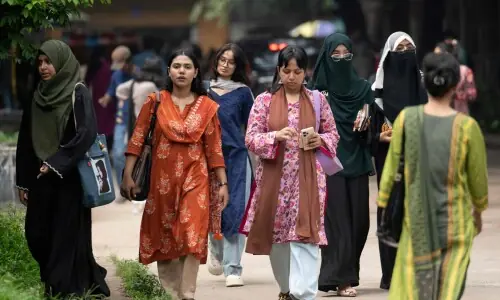
The removal sparked demonstrations outside the court premises and on the Dhaka University campus.
Police fired rubber bullets, tear gas and water cannons to disperse hundreds of students and left-wing activists protesting the removal, according to an AFP photographer at the scene.
“It is a betrayal of the people. The depressing thing is that the government is using it as a political tool,” top secular activist Imran Sarkar told AFP.
Haque said the authorities had “bowed to the Hefazat (-e-Islam),” referring to the hardline Islamist group that held a series of protests demanding the statue's destruction.
There was no official comment from the court or the government, but the attorney general said the removal had been discussed in the court on Thursday.
“It was a decision of the court,” he told AFP.
Bangladeshi Prime Minister Sheikh Hasina, who leads the secular Awami League party, initially remained at a distance from the row.
She broke her silence last month to describe the statue as “ridiculous” after inviting top Islamist leaders to her residence.
“I don't like it myself. It's being called a Greek statue, but how did a Greek statue get here?” she said. Sculptor Haque rejected that claim.
“It is a piece of sculpture of a Bengali woman wearing a traditional sari, blouse, petticoat and bangles,” he said.
Analysts said Hasina's stand on the statue was part of her efforts to woo the hardliners and the country's conservative rural electorate ahead of the general election, expected to be held some time next year.
Conservative Bangladesh has experienced increasing tensions between hardliners and secularists in recent years, suffering a spate of killings of atheist bloggers, religious minorities and foreigners.
Hefazat thanked Hasina.
“Her action has prevented the country from a destabilising and confrontational situation,” spokesman Azizul Hoque Islamabadi told AFP.