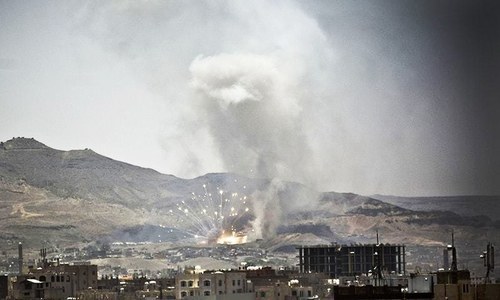
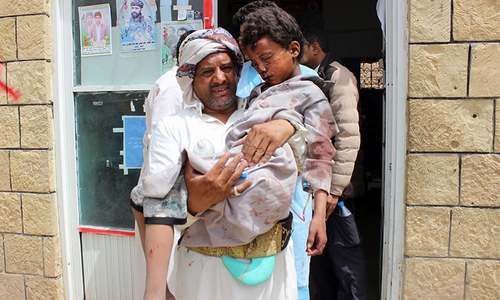
All sides in Yemen's bloody conflict may have committed war crimes, UN investigators said on Tuesday, highlighting deadly air strikes, rampant sexual violence, and the recruitment of young children as soldiers.
In their first report, a team of UN-mandated investigators said they had “reasonable grounds to believe that the parties to the armed conflict in Yemen have committed a substantial number of violations of international humanitarian law.”
Many of these violations may amount to “war crimes”, the report said, pointing to widespread arbitrary detention, rape, torture and the recruitment of children as young as eight to take part in hostilities.
Kamel Jendoubi, who heads the UN's so-called Group of Independent Eminent International and Regional Experts, said the investigators had identified a number of alleged perpetrators.
“A confidential list of these individuals will be presented today to the (UN) High Commissioner” for Human Rights, he told journalists in Geneva.
The devastating conflict in Yemen has left nearly 10,000 people dead since March 2015, when a Saudi-led coalition intervened to fight Houthi rebels closing in on the last bastion of President Abedrabbo Mansour Hadi's government.
The UN human rights office said on Tuesday that some 6,660 civilians were among the dead, while more than 10,500 had been injured.
The UN has meanwhile described the situation in Yemen as world's worst humanitarian crisis.
The UN expert group, which was created by the UN Human Rights Council last September and which needs that body's permission next month to continue its work, detailed a long line of abuses committed by all parties to the conflict.
“There is little evidence of any attempt by parties to the conflict to minimise civilian casualties,” Jendoubi said.
The report concluded that “coalition air strikes have caused most of the documented civilian casualties,” pointing to a large number of strikes on residential areas, markets, funerals, weddings, detention facilities, civilian boats and medical facilities.
The report said there were “serious concerns about the targeting process applied by the coalition,” pointing out that in many cases there were no apparent military targets in the vicinity of the attacks.
Child soldiers
The report covers the period from September 2014 through June 2018, and does not address the latest series of deadly strikes that have killed dozens of children in rebel-held areas and sparked international outrage.
The coalition has not confirmed or denied it carried out two air raids last Thursday that the UN said killed at least 26 children and four women south of the flashpoint rebel-held city of Hodeida.
Those deaths came after a coalition attack on a bus in the northern rebel stronghold of Saada early this month killed 40 children, prompting UN Secretary-General Antonio Guterres to call for an independent investigation of attacks targeting civilians in the three-year war.
Children have not only died in air strikes in Yemen.
“Children are the most vulnerable. Poverty, coupled with violence and insecurity render them defenceless and exposed to exploitation and abuse by parties to the conflict,” Charles Garraway, a member of the expert group, told reporters.
The experts said they had received “substantial information” indicating that Yemen's government, the coalition-backed forces and the rebels had all conscripted children, mainly aged 11 and up, but some as young as eight.
The report also decried the devastating impact a blockade imposed by the Saudi coalition on Yemen's ports and the Sanaa airport had had on the civilian population.
Jendoubi urged an end to “disproportionate restrictions on the safe and expeditious entry into Yemen of humanitarian supplies and other goods indispensable to the civilian population.”
The experts did not delve into the complex web of countries supporting different parties to Yemen's conflict, including the United States, Britain and Iran, but did call on all nations to stop selling arms that could be used in the war.
They also called on all sides to halt hostilities, and urged support for UN efforts to broker a peace deal. UN-backed talks between Yemen's government and the Houthis are to open in Geneva on September 6 — a first step toward resuming peace negotiations that broke down two years ago.
“This crisis has reached its peak with no apparent sight of light at the end of the tunnel,” Garraway said.