Delay in approvals, disbursements hits CPEC western route projects


ISLAMABAD: The delay in project approvals by China and non-disbursement of funds allocated in the Public Sector Development Programme (PSDP) because of political transition has hit the implementation of Western Route of the China-Pakistan Economic Corridor (CPEC).
This was disclosed by the National Highway Authority (NHA) in a presentation to the Senate Standing Committee on Planning and Development on Monday.
An official of the highway authority informed the committee that some Rs25 billion allocated in the PSDP for road projects under the Western Route was not released because of successive changes in the government over a short period of time.
Likewise, the Chinese government was also taking time in approval of projects during the intervening period. “This has brought work on roads to stand still,” the official said.
The committee meeting, presided over by Senator Agha Shazeb Durrani, was informed that work on the Hakla-Dera Ismail Khan Motorway project was not progressing due to funding issues. Similarly, delay on the part of China in the approval of construction work on the Western Route from Dera Ismail Khan to Zhob was an issue.
Senator Usman Kakar alleged that there was no developmental work on the Western Route from the past two and a half years.
There was an allocation of only Rs6 billion in the PSDP for the Western Route during the current fiscal, he added.
The committee chairman directed that work must be expedited on the western route of CPEC and projects must be completed.
While briefing the committee, Project Director CPEC, Planning Commission, Hassan Daud Butt said that Pakistan had acquired $6bn loans for infrastructure projects. The grace period for 90 per cent projects was currently in progress, he added. Sharing details, he said a total investment of $36bn was made by Chinese companies in 22 development projects including 15 in the energy sector.
Work was underway on 15 energy projects of 11,110 MW and four projects of 2,544 MW were being actively promoted. Mr Butt said so far a loan of $8.13bn for railways project ML-1 had not been received.
The committee was informed that the total portfolio of CPEC projects was $47.967bn. This includes $34.18bn of energy projects in IPP financing mode, $4.18bn concessional loan for transport and infrastructure projects, $8.212bn loan for rail network – ML-1 (government commercial loan under discussion), $780.6 million for Gwadar Port (combination of grant, government commercial loan and interest free loan) and $48m grant and government commercial loan for other projects including Gwadar City Master Plan.
Another official of the Planning Commission told the committee that the price of electricity per unit would start decreasing in coming days due to competitive bidding process. He said the average price of electricity was Rs8.5 per unit at imported coal and Rs8 per unit at local coal and Rs9.5 at LNG fuel. He said the cost of power production from solar energy had come down through bidding process to Rs5 per unit from more than Rs15 per unit a couple of years ago.
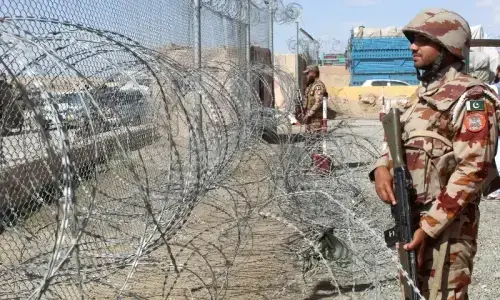
About the security of CPEC projects, Mr Butt told the committee that a total of 9,929 military troops and 4,502 civilians were available for security. A total of 10,000 Chinese and 65,000 Pakistanis were working on various CPEC projects while a total of eight investors – four each from Pakistan and China – had signed MoUs in Gwadar Free Zone, the committee was briefed.
The committee chairman said that locals should be appointed for security of CPEC projects.
On the occasion, committee members – particularity from Balochistan – expressed serious concern over the shortage of water and electricity in Gwadar city and slow pace of work on the Western Route under CPEC.
They said that 300,000 gallons of water was being supplied to Gwadar City per day while total demand was six million gallons per day. The committee recommended that the new government should resolve issues of water, electricity and security in Gwadar port city on priority.
Published in Dawn, September 4th, 2018