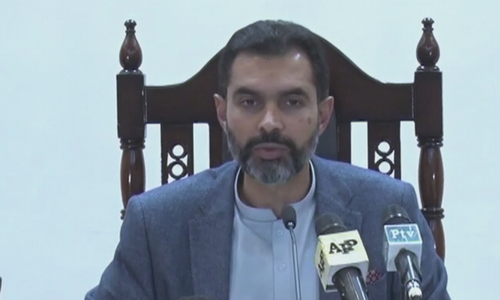
Asad Umar says inflation will peak in next few months and then slowly start going down


Former finance minister and PTI leader Asad Umar on Tuesday said that according to his assessment inflation rates would peak in the next two to four months.
While on Geo News' programme 'Aaj Shahzeb Khanzada Kay Saath', Umar said that after the two to four-month period, slowly the inflation rate would start going down. He said that this would then be reflected in the monetary policy and interest rates would also go down.
The former finance minister was responding to a question regarding keeping a fiscal deficit of 7.1 per cent along with a revenue target of Rs5.5 trillion. Anchor Shazeb Khanzada asked Umar if this was the one target to focus on.
Read: Govt projects 6.5-7pc fiscal deficit for 2018-19
In response, Umar said that revenue targets affect the economy in many ways and this was a central factor that needed to be looked at. However, he said that during the period of adjustment when they were getting out of a balance of payments crisis, the fiscal deficit was not the primary factor to look at.
He explained that this was because during this time, in order for demand compression and overcome losses in the energy system, decisions are made that increase inflation and to counteract that policy rates have to be increased.
"A big reason for the increase in the fiscal deficit is due to policy decisions of increasing inflation," he said, adding that even in discussions with the International Monetary Fund (IMF) the target focus was the primary deficit.
While giving his analysis that inflation would peak over the next few months and then slowly go down, Umar said that right now it was important to pay attention to whether progress was being made on the primary deficit. He said this year there was less progress than they wanted and hoped that next year there would be further progress.
Earlier in the month, State Bank of Pakistan (SBP) raised its main policy rate by 100 basis points to 13.25 per cent, citing increased inflationary pressures and a likely near-term rise in prices from higher utility costs.
At the time, SBP Governor Reza Baqir had said: "If you look at the time-path of this inflation, in the next few months, due to one-time factors, inflation will be higher. These have been accounted for [in our projections]. In the second half of the fiscal year, according to our projections, inflation will be lower. By the start of the next fiscal year, there will be a noticeable decrease in inflation."
In Tuesday's interview, Khanzada asked the PTI leader if the (economic) situation had improved or worsened since he had left his post as finance minister.
"The direction hasn't changed [they] are still going in the same direction adopted by the PTI government from day one," Umar replied, adding that there are multiple views about every individual decision.
He said that the overall direction was firstly to take Pakistan out of the "worst balance of payments crisis in [its] history" and noted that some "milestones" had been reached in achieving this.
The former finance minister was asked if the direction, based on a model going towards exportable surplus and import substitution, was correct and whether the country would go into a crisis again.
"This will be the real test because the way of getting out of a balance of payments crisis is a classic textbook way of demand and import compression," he said, adding that the "real test" would unfold over the next couple of years regarding two areas: how is the competitiveness of the economy improved and the revenue target.
Khanzada said that a revenue target of 35 per cent with GDP growth of 2.4pc had never been achieved and asked Umar if it was possible.
"It is a very big challenge," he responded, adding that currently, Federal Board of Revenue (FBR) Chairman Shabbar Zaidi had the most difficult job.