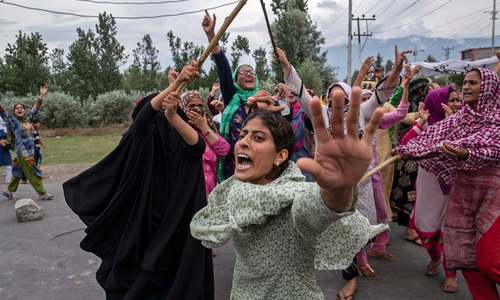
The few images, photos and videos, that trickle out of occupied Kashmir chronicling the travails of the Kashmiris are heart-rending and a couple of days ahead of Eid it was not difficult to imagine that the valley would be seeing next to nothing in terms of a celebration.
Since August last year, when New Delhi revoked Article 370, which gave occupied Kashmir special status, and annexed the disputed territory, a lockdown has been in place. That unilateral annexation was followed by unprecedented oppression even by the appalling standards seen there over the years.
Many of these images, shot by Associated Press photographers Dar Yasin and Mukhtar Khan in Srinagar and Channi Anand in Jammu, enabled the world to see the Indian’s state brutality and the defiant resistance being put up by the Kashmiris, and won the 2020 Pulitzer Prize in the process.
The Pulitzer Prize brought some cheer to the beleaguered Kashmiri journalists who have mostly worked without internet and mobile data services for some eight and a half months in a hostile, oppressive environment.
Prize-winning images tell the story of human tragedy unleashed by the Indian state.
These prize-winning images tell the story of human tragedy unleashed by the state which does not even spare little, unarmed children, injuring, blinding or even killing them with shotguns fired directly at them; they have captured the pain, the tears and the helpless loss on the faces of mothers of martyrs.
Read: 3 AP photographers win Pulitzer for coverage of occupied Kashmir after India's annexation
The cameras captured distraught, poor people standing on the rubble or the gutted remains of their homes destroyed by the security forces to teach them a lesson: that their defiance comes at a high price. But the Kashmiri spirit remains unbroken.
This unbroken spirit is manifested each time young men, who have taken up arms against the occupation forces, lay down their lives. Their funerals are marked by hundreds of people, defying the authorities, and congregating to pay their tributes.
Read: Maths teacher-turned-top Kashmiri fighter killed by Indian troops
Such funerals are marked by the grief of the affected families, whose wailing and lamentation rend the air. Equally poignant is how the fallen fighters are remembered by the rest. In contemptuous disregard of the heavy security presence around them, they raise vociferous "azadi" slogans.
Apart from 1948 when Pakistan was able to wrest a part of Kashmiri territory from India, history has showed that militarily operations whenever initiated have not yielded the desired results. This has happened more than once.
In 1965, when a proud son of Pakistan, Maj-Gen (later Lt-Gen) Akhtar Husain Malik, was removed midway through Operation Grand Slam as troops under his brilliant command were poised to take the valley, GHQ replaced him with Yahya Khan. The operation stalled and lost all momentum never to be regained. And to this day there is no explanation, let alone inquiry, for the decision.
The insurgency of the 1980s and the 1990s, when a large number of armed and trained militants entered the valley and started to bleed the Indian security forces, was never going to lead to the liberation of Kashmir, even if it did leave the Indian security forces traumatised.
Here too the price of that "success" was paid by the Kashmiris whose own Sufi-leaning Islam was supplanted by extremist denominations which were alien to the people and culture of the valley. Also, these militants’ conduct discredited the indigenous freedom movement and led to allegations of it being foreign-inspired.
Although the historical visit to Lahore in February 1999 by then prime minister Atal Behari Vajpayee fuelled optimism about a peace deal, it was followed by the Kargil (mis)adventure initiated by the army chief Gen Pervez Musharraf and some of his close confidantes.
The Kargil conflict, so soon after our nuclear tests, led to Pakistan being dubbed an "irresponsible state" by the international community, caused heavy loss of life of our brave Northern Light Infantry men, and a stalemate which was only resolved after we agreed to a climbdown.
Less than two years after staging a military coup in October 1999, the architect of the Kargil operation arrived in Agra sold on the idea of negotiating a peace deal with India. At one stage, all seemed to be in order for the deal to be inked.
Behind the scenes, hard-line elements in the governing BJP were unhappy with what they saw as Vajpayee’s concessions to Pakistan. Gen Musharraf’s bravado before the Indian media personnel gave the extremist elements an opportunity to play their hand. It is safe to assume they would have found another excuse even had Musharraf not spoken.
A few years later, Pakistan and India came close to agreement again when Musharraf and (Congress) prime minister Manmohan Singh reached a four-point formula and de-escalation followed. Then, Musharraf triggered a domestic crisis by sacking his chief justice in 2007. The rest is history.
One thing is clear. What Musharraf rather sensibly agreed with Singh reflected the ground reality in Kashmir and the region. Both sides offered concessions and moved away from their historical stance on the issue for peace. Frankly, no civilian leader here would have been able to offer as much.
Nawaz Sharif was castigated for merely trying to engage with Modi when the latter became prime minister. His patriotism was questioned and baseless allegations were made that Sharif’s move was driven by business interests.
Eight and a half months after India’s unilateral annexation of Kashmir, amid mounting agony for the Kashmiris, the Pakistani response seems hamstrung apart from a lot of talk. The Kashmiris’ indomitable will and their burning desire for freedom appear to be the only obstacles in the extremist, authoritarian BJP’s path.
The writer is a former editor of Dawn.
Published in Dawn, May 24th, 2020