WHO looking at situation through 'health lens' alone, govt policies based on holistic picture: Mirza


Special Assistant to the Prime Minister on Health Dr Zafar Mirza on Wednesday said that the World Health Organisation is viewing the Covid-19 situation in the country through a "health lens" whereas the government has to look at the "holistic picture".
He was referring to a letter from the world health body in which it had recommended that the country impose an "intermittent lockdown" to curb the spread of Covid-19, noting that the country doesn't meet any prerequisites for lifting restrictions as was done on May 1 and then on May 22.
The letter dated June 7 was penned by Dr Palitha Mahipala, WHO Country Head for Pakistan, and stated that the coronavirus has spread to almost all districts in the country, with major cities making up a majority of national cases.
"The government's choice of policies has been guided by the best evidence available about the disease spread and our best assessment of the fast deteriorating socio-economic conditions in the country," the SAPM responded in a statement.
Mirza said that the government was pursuing a "holistic strategy to combat the coronavirus". He added that a ministerial level meeting took place at the National Command and Operation Centre (NCOC) every day in which the government with the help of experts "reviewed the disease data and trends very minutely and took a holistic view of the situation along with the provinces and developed recommendations".
The SAPM said Pakistan was a low middle-income country where two thirds of the people were dependent on day-to-day earnings. "[The government] has made best sovereign decisions in the best interest of our people," Mirza said.
He added, however, that the government has to make "tough policy choices" to maintain the balance between lives and livelihoods. He said that although the lockdown had been eased, there was increased focus on enforcing the standard operating procedures (SOPs) issued by the government to prevent the spread of the virus.
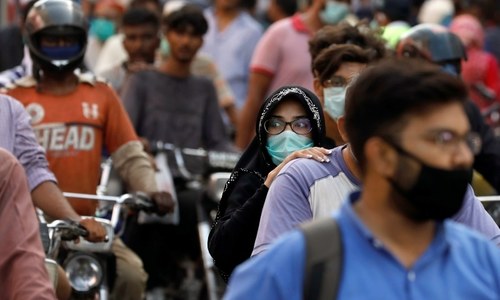
He noted that wearing masks in public had been made compulsory and the government had developed a "robust" mechanism for dealing with the spread of Covid-19 which includes tracing, testing and quarantine to identify and seal off hotspots. He added that another strategy included shoring up the health system to cope with the influx of patients.
Mirza said the government "appreciated" the WHO's recommendations but it had to look at a "holistic picture and make decisions on relative risk assessment basis".
"This has been the case in Pakistan all along," he added.
Pakistan meets no prerequisites for ending lockdown: WHO
The WHO, in its letter, said that Pakistan has been ranked among the top 10 countries in the world reporting the highest number of new cases of Covid-19 and advised the government to enhance daily testing capacity to 50,000 to assess the actual prevalence of coronavirus across the country.
While expressing concern over the hasty lifting of restrictions, the WHO said Pakistan did not meet any of the prerequisites for opening of the lockdown.
It also alerted Pakistan to its high positivity rate, underlining seriousness of the Covid-19 situation and poor efforts of the government in this regard.
As a strategy to help contain the massive transmission of coronavirus, the WHO recommended the imposition of a two-week lockdown. "WHO strongly recommends the two weeks off and two weeks on strategy as it offers the smallest curve," the letter said.
Alerting Pakistan to its high positivity with weak surveillance system, the WHO said: "The positivity rate is high at 24 per cent (above the required level of 5pc), the surveillance system (identify, test, isolate, care for the ill including identification and follow up of contacts and quarantining) is weak.
“Decisions will require the need to balance response directly to Covid-19, which includes intermittent lockdowns of target areas (districts, towns, section of the town or village) as a first option and should be dealt on priority basis while simultaneously engaging in strategic planning and coordinated action to maintain essential health services delivery, mitigating the risk of system collapse,” the letter added.