Louvre reopens after 16-week coronavirus shutdown
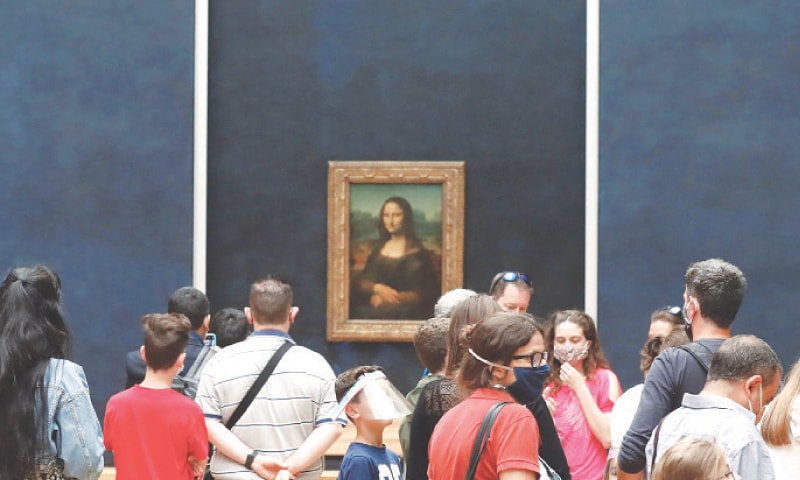

PARIS: The world’s most visited museum, the Louvre in Paris, reopened on Monday after nearly four months of coronavirus closure, with a restricted number of visitors enjoying a rare chance to view the “Mona Lisa” without the usual throngs.
Several dozen visitors queued outside the vast former palace of France’s kings, eagerly awaiting the opening at 9am (0700 GMT) as the famed museum hopes to start recuperating losses estimated at more than 40 million euros ($45 million) due to the lockdown.
The museum’s most popular draws, including Leonardo’s Mona Lisa, the Venus de Milo, and the Louvre’s vast antiquities collection will be accessible.
But galleries in which social distancing is more difficult, about a third of the total, will remain off-limits and visitor numbers were capped at 500 per half hour in a bid to reduce contact between people and lower coronavirus transmission risk.
Face masks are compulsory and no snacks or cloakrooms were available.
Tickets must be bought beforehand online, and were sold out for the first day of reopening after the Louvre’s longest closure since World War II.
“Some 7,000 people have reserved tickets, normally we host about 30,000 people” per day, said museum director Jean-Luc Martinez, who expects tough months and years ahead.
The museum will not get any anywhere near the 9.6 million visitors it hosted last year — down from a record 10 million in 2018. Nearly three-quarters of its visitors in a normal year are from abroad.
For Nicole Lamy, a 21-year-old visiting from Brussels, the limit on ticket sales was an opportunity to see the Mona Lisa up close and not in a crowd.
“It’s a bit selfish but I think I’m lucky with my first visit to the Louvre.” Also in the queue was Arzel Bertrand from Maisons-Alfort southeast of Paris, who said he and his friends also came early seeking a more solitary museum experience.
“We thought it was the first day of the reopening, that there might be fewer people than usual, and we wanted to walk around the Louvre without anyone.” But they also came in a show of cultural solidarity.
“It is very important that cultural establishments can welcome the public because we need it, and they need the public, too, to survive. So we’re here for that, too,” said Bertrand.
Several measures were put in place to allow ticket holders to keep a safe distance from one another.
Published in Dawn, July 7th, 2020