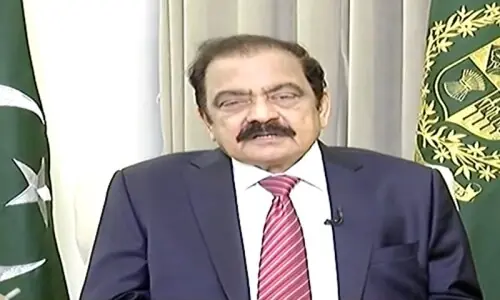
THE government appears to have finally agreed upon some sort of framework for dealing with state-owned enterprises which have negatively impacted the economy both in terms of fiscal losses and poor, cost-ineffective service delivery. While the full details of the strategy formulated to handle SOEs are still awaited, it seems from what the prime minister’s adviser on institutional reforms, Dr Ishrat Husain, has said, that the government is moving towards a mixed ownership model, which has successfully been employed in several countries to manage large public enterprises.
The journey towards this model will begin with the division of SOEs such as the Pakistan Railways, PIA and Pakistan Steel Mills into smaller companies operating different businesses that are currently being managed by the parent entity. In some cases, the authorities have prepared financial restructuring plans to revive companies such as PIA. The “unbundling and financial restructuring” of these entities will be followed by retrenchments, or rightsizing, of employees — always a matter of concern — and the divestment of assets like excess land in the case of PSM. Additionally, the government plans to hire ‘competent’ individuals, most likely Pakistanis living abroad, for senior positions in the new entities.
Governments have attempted to take care of these enterprises since the 1980s with some success in certain sectors and total failure in others. Most large banks, and cement, fertiliser, telecom and other businesses were successfully deregulated and sold to the private sector as the initial emphasis of policymakers shifted from supporting public-sector enterprises to their privatisation in the 1990s and beyond. While the move proved successful in certain cases, the attempts to reform or sell power companies failed except in the case of the divestment of KESC. Likewise, repeated attempts to restructure and reform PIA, PR and PSM have also proved futile — in fact, affairs at these organisations have worsened.
Previously, we have seen various governments pursue different strategies and fail because of the absence of an overall policy and framework for managing SOEs. Past reforms and strategies to fix SOEs were based on the assumption that privatisation was the only solution to fix public-sector businesses. In reality, the SOEs are seen as an “essential element of most economies, including many more advanced economies … especially in strategic sectors such as energy, minerals, infrastructure … and … financial services”.
According to the OECD, public-sector organisations have come to constitute more than a fifth of the “world’s largest enterprises”. In Pakistan, had they been managed properly, these entities could have been the primary vehicle of fast-paced performance as seen in other countries. Instead, the burden of inefficient SOEs on the economy has become too large for any government to handle, and allowing the damage to fester will only exacerbate the challenge. But in countries like Pakistan, everything cannot be left to privatisation either — which is why a mixed ownership model merits serious discussion.
Published in Dawn, November 23rd, 2020