Court rules unelected aides to PM can’t head govt bodies


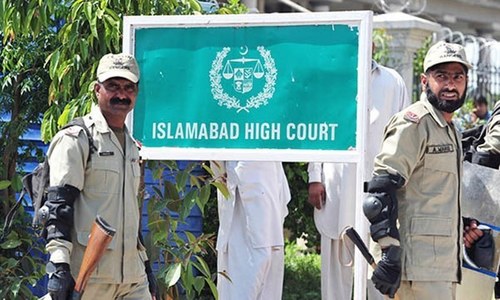
ISLAMABAD: In what may come as a major blow to the privatisation process being spearheaded by some unelected members of the federal government, the Islamabad High Court (IHC) on Monday set aside the notification regarding formation of the Cabinet Committee on Privatisation (CCoP) last year.
The IHC, in its short order on a petition, ruled that unelected advisers and special assistants could not head government’s committees and subsequently set aside the notification of the CCoP, headed by Adviser to Prime Minister on Finance and Revenue Abdul Hafeez Shaikh.
A detailed order on the challenge is expected over the next few days.
While deciding the petition filed by a member of the National Assembly, Justice Aamer Farooq held that unelected advisers and special assistants could not interfere into the executive’s domain.
Sets aside notification about formation of cabinet committee on privatisation
The petition, which was submitted by lawmaker Rana Iradat Sharif Khan through his counsel Barrister Mohsin Shahnawaz Ranjha, had challenged the appointment of Mr Shaikh as chairman and Adviser to the PM on Commerce and Investment Abdul Razak Dawood and Adviser to the PM on Institutional Reforms and Austerity Dr Ishrat Hussain as members of the CCoP.
According to the prosecution, it is a settled rule that the cabinet constitutes the prime minister and ministers, who are the elected members of parliament.
Lawmaker Iradat Sharif had challenged the April 25, 2019 notification that nominated Adviser to the Prime Minister on Finance and Revenue Hafeez Shaikh, Adviser to the PM on Commerce and Investment Abdul Razak Dawood, Adviser to the PM on Institutional Reforms and Austerity Dr Ishrat Hussain, Minister for Communications Murad Saeed, Senator Farogh Naseem, Minister for Planning and Development Asad Umar, Minister for Privatisation Mohammadmian Soomro and Minister for Power Omar Ayub Khan as members of the CCoP.
The induction of three advisers Mr Shaikh, Mr Dawood and Dr Hussain, who were not elected by the people of Pakistan, into the CCoP was challenged before the court.
Barrister Ranjha argued that Pakistan could be governed only by elected representatives of the masses and a person who was not a member of the parliament could neither become a part of the cabinet nor its committees.
The petition said: “Unlike ministers, advisers are not the part of the federal government, they do not take oath, they are not responsible to parliament in terms of Article 91(6) of the Constitution, they are not subject to the qualification and disqualification provided under Articles 62 and 63 of the Constitution. Before and after their appointment, advisers are not bound to submit their statements of assets and liabilities…and they are not subject to any kind of scrutiny.”
Earlier in August, IHC Chief Justice Athar Minallah while disposing of the petition filed against the appointment of Adviser to the Prime Minister on Interior Mirza Shahzad Akbar had declared that unelected advisers and special assistants to the prime minister could not exercise executive or administrative powers in the functioning of the government and only elected representatives chosen by people had the privilege to run the affairs of ministries.
The chief justice also observed that it was the prime minister’s prerogative to select any person for giving him advice. However, he ruled that any executive function performed by any unelected member of the prime minister’s team would deem to have been taken illegally without any lawful authority and hence void.
“Appointing an Adviser with the status of a Minister does not empower him/her to act or function as a Minister or to perform functions under the Rules of Business 1973,” declared the court verdict.
Published in Dawn, December 8th, 2020