Global Covid death toll tops 5 million


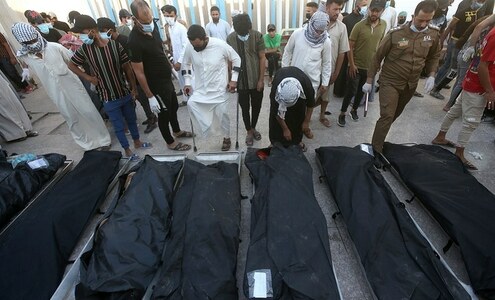
WASHINGTON: The global death toll from Covid-19 topped five million on Monday, less than two years into a crisis that has not only devastated poor countries but also humbled wealthy ones with first-rate health care systems.
Together, the United States, the European Union, Britain and Brazil all upper-middle- or high-income countries account for one-eighth of the world’s population but nearly half of all reported deaths. The US alone has recorded over 740,000 lives lost, more than any other nation.
This is a defining moment in our lifetime, said Dr Albert Ko, an infectious disease specialist at the Yale School of Public Health. What do we have to do to protect ourselves so we don’t get to another 5 million? The death toll, as tallied by Johns Hopkins University, is about equal to the populations of Los Angeles and San Francisco combined. It rivals the number of people killed in battles among nations since 1950, according to estimates from the Peace Research Institute Oslo. Globally, Covid-19 is now the third leading cause of death, after heart disease and stroke.
The staggering figure is almost certainly an undercount because of limited testing and people dying at home without medical attention, especially in poor parts of the world, such as India.
Hot spots have shifted over the 22 months since the outbreak began, turning different places on the world map red. Now, the virus is pummeling Russia, Ukraine and other parts of Eastern Europe, especially where rumours, misinformation and distrust in government have hobbled vaccination efforts. In Ukraine, only 17% of the adult population is fully vaccinated; in Armenia, only 7%.
What is uniquely different about this pandemic is it hit hardest the high-resource countries, said Dr Wafaa El-Sadr, director of ICAP, a global health centre at Columbia University. That is the irony of Covid-19.
Wealthier nations with longer life expectancies have larger proportions of older people, cancer survivors and nursing home residents, all of whom are especially vulnerable to Covid-19, El-Sadr noted. Poorer countries tend to have larger shares of children, teens and young adults, who are less likely to fall seriously ill from the coronavirus.
India, despite its terrifying delta surge that peaked in early May, now has a much lower reported daily death rate than wealthier Russia, the US or Britain, though there is uncertainty around its figures.
The seeming disconnect between wealth and health is a paradox that disease experts will be pondering for years.
Published in Dawn, November 2nd, 2021