Parliamentary system experiencing ‘stress and flux’, says CJP


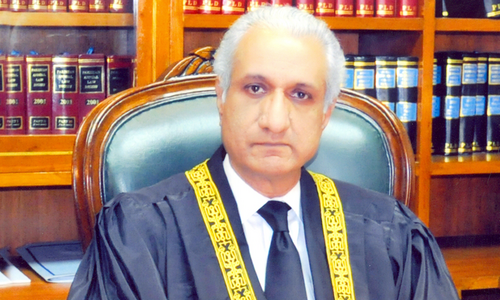
ISLAMABAD: Chief Justice of Pakistan (CJP) Umar Ata Bandial on Wednesday expressed his concern over the recent happenings on the political front, noting that the parliamentary system was going through “stress, flux and instability”.
“Everything comes to the court and we have to decide even intra-party disputes,” the CJP observed while hearing the presidential reference seeking interpretation of Article 63A of the Constitution, which pertains to defection.
Justice Bandial said the court had to determine whether the defection clause was just a “piece of decoration” in the Constitution or it was inserted with an eye on stability of the system.
The apex court had to judge whether the discretion vested in the parliamentary head of a party under Article 63A had made this provision redundant since it was up to this individual on one hand to remain silent by not initiating any action for defection against an influential member and, on the other, punish an ordinary member for the same act, the CJP said.
Justice Bandial asked the newly appointed attorney general for Pakistan (AGP), Ashtar Ausaf, to ponder over these questions and come up with his reply on Monday. The AGP said he was hopeful the court’s decision in the case would put the country’s political order on the road to stability.
Justice Munib Akhtar, a member of the bench, cited as examples the parliamentary practices prevalent in Britain, Canada and Australia. These demand strict adherence to the party discipline as parliamentary democracy cannot survive without it.
The entire system will collapse and “there will be chaos all around us”, Justice Munib said.
No party would be able to execute its agenda without discipline in its ranks, the judge observed. “Article 63A seems to have been included in the Constitution to banish defection forever.”
Justice Akhtar reiterated that under Article 17, it was the fundamental right of a political party, and not of an individual, to form the government.
If a certain member disagrees views the party line, it would be better for the “conscious objector” to resign his seat in parliament and contest the by-election.
“Speaking for myself,” Justice Ahsan explained, “merely depriving a legislator of an assembly seat for committing defection is no punishment.
“The perpetrator should not be allowed to go scot-free since he has tried to undermine the democratic order. Defection per se is a constitutional offence.”
Justice Jamal Khan Mandokhel, addressing Advocate Azhar Siddique who represents the PML-Q, wondered why the party did not take action against those of its members who sided with other parties during the crisis last month.
Justice Mandokhel recalled that a member of the Balochistan Assembly was de-seated recently for deviating from the party line during the vote on a no-confidence motion against the chief minister, but later become a senator and was still present in the upper house.
Advocate Mansoor Usman Awan, representing the Supreme Court Bar Association (SCBA), argued that a life-time ban or disqualification for a limited period should not be read into Article 63A, either on account of reading it with any of the provisions stipulated under Articles 62 and 63 or independently relying on the decision in appeal given by this court under Article 63A(5).
He argued that Article 63A(4) cannot have an effect different from Article 63 (3), emphasising a legislator should be allowed to contest by-elections after having been de-seated.
Dwelling on an argument that the vote of a member belongs to a political party, Mansoor Awan described the assumption as problematic. “The Constitution itself allows members to vote in accordance with their conscience on all matters other than those mentioned in Article 63A.”
About independent candidates, he contended that the Constitution permits them to join a party after elections, but then they become subject to the party discipline and face the consequence of being de-seated in case of any deviation. He said hardly any political party holds intra-party elections and even the few which tried once or twice, later gave up.
“Voters do not vote along party lines only. Quite often a particular candidate’s clout acts as the deciding factor,” Mansoor Awan added.
Published in Dawn, May 12th, 2022