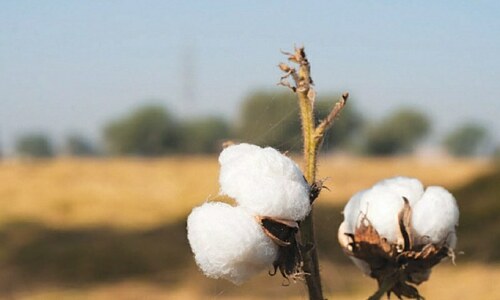
LAHORE: Cotton production has dropped by more than 40 per cent mainly because of climate change and floods giving a nightmare to the country’s ‘financial wizards’ as the foreign exchange-starved country will have to import about 7 million cotton bales to meet the textile industry’s demand this season.
Total white lint production is expected to be barely 4.8m bales this year, raising the cotton import demand to 7m bales, while so far import contracts of around 5m bales have been signed.
The Pakistan Cotton Ginners Association (PCGA) on Monday reported that cotton production remained 40.28pc less than the last year’s harvest by Dec 1, an alarming drop of 2.9m bales. Last year, Pakistan produced over 7.168m bales before the start of December against 4.28m bales this year.
Dollar-starved Pakistan will have to import 7m bales to meet industry’s demand
During this period, the export of cotton was 4,900 bales, which is 11,100 bales or 69.38pc less than the export of 16,000 bales in the same period last year. Textile mills bought over 3.568m bales against 3.19m bales or 46.56pc less than last year’s purchases of around 6.7m bales. Ginners have a stock of 0.767m bales, 49.25pc higher than last year’s stock of 0.473m bales.
Karachi Cotton Brokers Forum chairman Naseem Usman told Dawn that the country will be able to produce barely 4.8m bales this season and 6 to 7m bales will have to be imported to keep the textile factories running.
Quoting cotton importers, he said that so far import agreements for about 5m bales had been made.
PCGA leader Javaid Suhail blames climate change, particularly heavy rains and floods in monsoon, for the drastic decline in cotton production. “At least 79pc cotton area, especially in Sindh, was hit by floods as gates of ginning factories could not open there this year.”
Only 2.01m hectares could be brought under the crop both in Punjab and Sindh against the combined 2.53m hectares target this season. Khalid Mahmood Khokhar, a farmers’ leader, said that cotton growers also didn’t follow good agriculture practices, while extension staff also misguided them about the use of herbal pesticides leading to a drop in crop output.
He argued that the agriculture authorities would have to adjust the cotton plantation period by sowing it during the months of February and March instead of May and June to counter climate change, which is badly affecting silver fibre production.
Published in Dawn, December 6th, 2022