India compels Pakistan to make difficult choices for survival: experts


ISLAMABAD: Continuing existential challenges due to hostile neighbourhood compel Pakistan to make difficult choices for survival.
This was the crux of a discussion on the first day of Islamabad Conclave-2022 themed ‘75 Years of Independence: Achieving Comprehensive National Security’, which was hosted by Institute of Strategic Studies Islamabad (ISSI).
Former Chairman Joint Chiefs of Staff Committee retired Gen Zubair Hayat, in his keynote speech, said the threat from India, which has been reluctant to accept Pakistan’s existence and posed challenges at variety of fronts and spectrums, had not diminished.
He recalled the statements by Indian leaders in which they mentioned the 1947 partition as “a historic wrong” and “distortion of history” and more recently warned of “moving north,” which was seen here as a “blatant threat”.
He further reminded that over the past five years there were “phantom and fake” surgical strikes claim, the 2019 Balakot incident – the first attack on the mainland, and the so-called “accidental” launch of missile into the country’s heartland.
Gen Hayat said a range of conflicts was imposed on Pakistan — full scale war to insurgencies and terrorism and more recently hybrid warfare. He noted that importantly the country was well defended against those challenges except for the 1971 East Pakistan debacle.
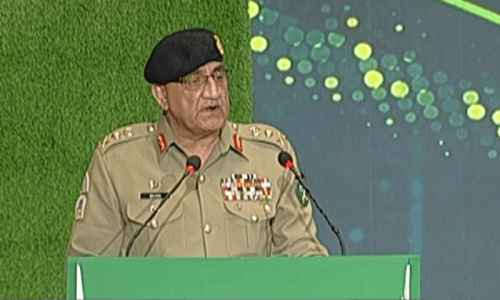
On 1971 tragedy, he echoed former Army Chief Gen Qamar Bajwa’s line, who in one of his parting speeches, had termed the defeat in East Pakistan as a political failure rather than a military fiasco.
“In military sense there was status quo and had there been not a direct foreign intervention by India, the insurgency too would have failed,” he maintained.
Dr Adil Sultan, Dean of the Faculty of Aerospace and Strategic Studies (FASS), Air University Islamabad, said the external environment required Pakistan to maintain robust nuclear and conventional capabilities, while remaining cognizant of the limited economic resources.
He said introduction of new technologies by India like ballistic missile defence systems, Anti Satellite weapons (ASAT), hypersonic missiles, Pakistan-specific MIRV missiles, and operationalising sea-based nuclear capability were straining the deterrence.
Mr Javed Jabbar, writer and politician, called for major political and economic reforms and controlling population growth.
Published in Dawn, December 8th, 2022