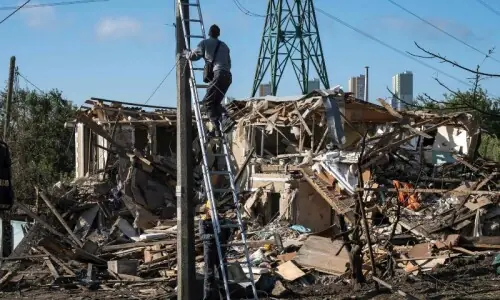
PARIS: The idea is seductively simple: The West should turn over billions of dollars of frozen Russian assets to Ukraine to fund reconstruction. But it faces major legal problems which mean little progress has been made.
After the Kremlin’s invasion of Ukraine last February, unprecedented economic sanctions against Moscow saw an estimated $350 billion in state assets, foreign reserves and oligarch property frozen by Western banks and officials.
Nearly 12 months on, politicians and campaigners in the West are pushing for this idle wealth to be put to work rebuilding the shattered infrastructure, homes and businesses destroyed during Russia’s aggression.
“So much damage has been done and the country that did the damage should pay,” Canadian Deputy Prime Minister and Finance Minister Chrystia Freeland told an audience at the World Economic Forum last month.
In December, Canada began proceedings for the first time to turn over around $26 million belonging to a sanctioned company owned by oligarch Roman Abramovich — something Russia’s ambassador likened to “robbery in broad daylight”.
Earlier this month, the European Commission pledged to “step up its work towards the use of Russia’s frozen assets to support Ukraine’s reconstruction”.
Poland and three Baltic states pressed publicly for action “as soon as possible”. Estonia has announced plans to be a frontrunner in the EU, drawing up its own confiscation plans.
“Putin broke it, he should fix it,” former US investor and activist Bill Browder, a dogged campaigner against the Kremlin, told in a recent interview.
The man behind the Magnitsky Act — pioneering legislation to sanction Russian government officials involved in human rights abuses — is now seeking to build pressure on lawmakers.
“There are 50 different alternative proposals for how to do it. And if you want to make sure that something never gets done, present 50 different proposals,” Browder said. The US Congress has been holding hearings on ways in which US law could be changed to enable permanent seizures, although President Joe Biden’s administration has been publicly cautious about the idea.
Proceeds of crime?
Legal experts make a distinction between private assets frozen by Western governments — such as an oligarch’s yacht — and state property, such as the foreign currency reserves of Russia’s central bank.
In the case of private assets, legal safeguards mean Western states are permitted to permanently seize them only in very limited circumstances — usually when they can be proven to be the proceeds of crime.
And even though Russian oligarchs operate in the murky weeds of Russian capitalism “we don’t really know that the properties that have been frozen are the proceeds of crime,” Anton Moiseienko from the Australian National University told.
Seizing them poses a challenge to fundamental legal and human rights, such as the right to property, protection from arbitrary punishment, or the right to a free trial.
The West’s public commitment to respecting the rule of law would also be on the line.
“How are you going to prove that they (the seized assets) constitute the proceeds of crime without the cooperation of Russia?” Moiseienko, an international law expert, added.
Published in Dawn, February 13th, 2023