Strong quake in west Afghanistan kills ‘about 120’



The death toll from an earthquake in western Afghanistan on Saturday has risen to around 120 with 1,000 more injured, disaster relief authorities said, as desperate families dug into the night to free relatives trapped in the rubble.
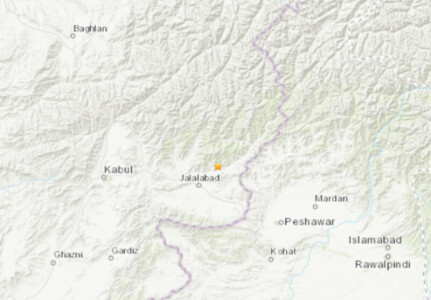
The United States Geological Survey said the epicentre of the magnitude 6.3 quake was 40 kilometres (25 miles) northwest of the region’s largest city Herat, and was followed by eight aftershocks with magnitudes between 4.3 and 6.3.
As night fell in Sarboland village of Zinda Jan district, in rural Herat province, an AFP reporter saw dozens of homes which had been razed to the ground near the epicentre of the earthquakes.
Groups of men with shovels dug through piles of crumbled masonry as women and children waited out in the open, with gutted homes displaying personal belongings flapping in a harsh wind.
“There was a big noise, and it didn’t give any time to react,” said 42-year-old Bashir Ahmad. “In the very first shake, all the houses collapsed.”
“Those who were inside the houses, they were buried,” he said. “There are families which we have heard no news from.” Nek Mohammad told AFP he was at work when the first quake struck at around 11:00 am (0630 GMT).
“We came home and saw that actually there was nothing left. Everything had turned to sand,” said the 32-year-old, adding that some 30 bodies had been recovered.
“So far, we have nothing. No blankets or anything else. We are here left out at night with our martyrs,” he said.
Herat province disaster management head Mosa Ashari told AFP that in addition to “about 120” killed, “more than 1,000 injured women, children, and old citizens have been included in our records”.
Panic in the city
Crowds of residents fled buildings in Herat city as the series of tremors began, although casualty reports from the metropolitan area were minimal. “We were in our offices and suddenly the building started shaking,” 45-year-old resident Bashir Ahmad told AFP.
“Wall plasters started to fall down and the walls got cracks, some walls and parts of the building collapsed,” he said.
“I am not able to contact my family, network connections are disconnected. I am too worried and scared, it was horrifying.” Men, women and children stood out in the wide streets, away from tall buildings, in the moments after the first quake and remained wary of returning to their homes as aftershocks rumbled for hours.
“The situation was very horrible, I have never experienced such a thing,” said 21-year-old student Idrees Arsala, the last to safely evacuate his classroom as the quakes began.
‘Significant casualties are likely’
Early on Saturday evening, disaster management authority spokesman Mullah Jan Sayeq told AFP that the number of fatalities was expected “to rise very high”.
Fatalities running into the hundreds were possible, according to a USGS preliminary estimate.
“Significant casualties are likely and the disaster is potentially widespread. Past events with this alert level have required a regional or national level response,” it said.
The USGS had earlier reported the first quake’s magnitude as 6.2. It had a shallow depth of just 14 kilometres, it said.
Herat — 120 kilometres east of the border with Iran — is considered the cultural capital of Afghanistan.
It is the capital of Herat province, which is home to an estimated population of 1.9 million, according to 2019 World Bank data.
Afghanistan is frequently hit by earthquakes, especially in the Hindu Kush mountain range, which lies near the junction of the Eurasian and Indian tectonic plates.
In June last year, more than 1,000 people were killed and tens of thousands left homeless after a 5.9-magnitude quake — the deadliest in Afghanistan in nearly a quarter of a century — struck the impoverished province of Paktika.
Afghanistan is already in the grip of a grinding humanitarian crisis, following the widespread withdrawal of foreign aid since the Taliban returned to power in 2021.