AS China recently celebrated 10 years of the Belt and Road Initiative, the mood remained sombre in Beijing largely because the “strategic competition” between China and the US has grown increasingly intense in the last few years.
The origins of this rivalry can be traced back to 2011, when president Obama was prevailed upon by China hawks to ‘Pivot to Asia’. At the time, US foreign policy experts argued that containing China required a long-term partnership with India as the two democracies not only shared common values, but India’s emergence as an economic and security anchor would also provide the necessary counterweight to China’s expansionary ambitions.
Predictably, in 2015, the Obama administration, pinning its hopes on India, declared that the US relationship with India “will be one of the defining partnerships of the 21st century”. It appears that US foreign policy experts might be in for a disappointment.
Earlier this year, Jake Sullivan, the US national security adviser, argued that since previous strategy had not been able to ensure American economic hegemony, a “new Washington Consensus” was required.
In other words, rapidly losing economic ground to China, the US would now employ the state in generating economic growth, something it had shunned in the era of markets-driven globalisation.
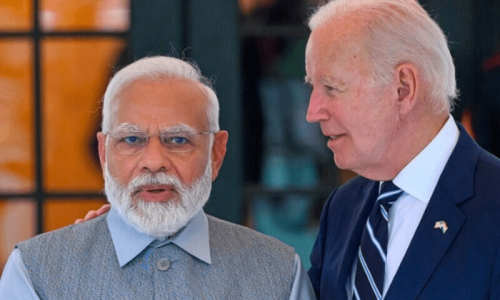
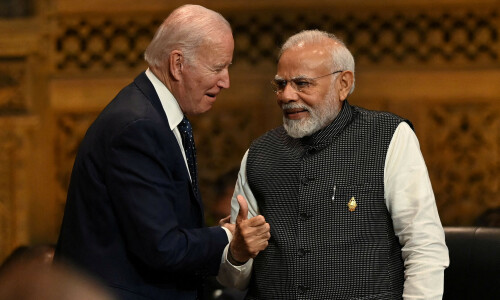
Since this new economic strategy is driven by competition from China, there were echoes of the old idea of using India as a counterweight. Where the US has tried to hobble Chinese progress in the semiconductor industry, Sullivan identified India as one of its ‘partners’ in taking its semiconductor industry forward.
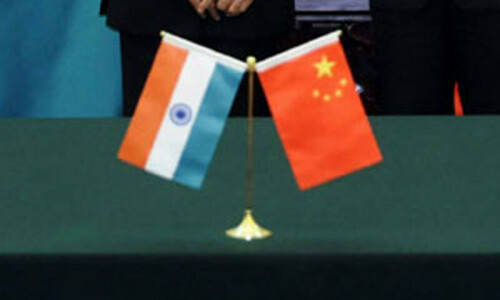
It seems that India and China have much to learn from each other.
American reliance on India for developing future technologies makes good economic sense as the numbers ostensibly are in India’s favour. Where the World Bank and Western media outlets are consistently reporting a growth slowdown in China — 4.4 per cent, the slowest since 1990 — India is powering ahead with an expected growth of 6.3pc this year.
Global investors are said to be taking their money out of China and investing it in India. Where the Chinese economy, purportedly, faces cyclical and structural headwinds — property crisis, low export growth, geopolitics — India’s economy is riding high on cyclical and structural tailwinds.
Sustained economic growth has also enabled India to increase its military spending by 50pc from $49.6 billion in 2011 to $76.6bn in 2021, according to the Stockholm International Peace Research Institute, making India the third biggest military spender, surpassing Russia and the UK.
India’s political system also appears sturdier than China’s. Domestically, China has not found a way to formally institutionalise democracy. This could turn out to be a stumbling block given that China needs to find a way to sustain the relationship between a communist state and a capitalist economy.
In contrast, India achieved this milestone a long time ago by consolidating democracy despite being one of the world’s poorest countries.
Given such stellar performance, have Chinese policymakers overlooked the existential challenge from India? Were US experts correct in pinning their hopes on India as the next Asian hegemon?
As they say, the devil is in the details.
Sadly, under the microscope, India’s impressive economic growth reveals some startling details. In India is Broken, Ashoka Mody takes issue with India’s official narrative of explosive growth.
Mody, a former IMF economist, cites international best practices for calculating GDP to show that India is overstating GDP growth by relying only on income as opposed to averaging both income and expenditure.
Using a well-rounded approach, Mody shows that India’s GDP growth in the first quarter (April-June) of 2023-24 would amount to 4.5pc, and not equal the official 7.8pc.
The quality of economic growth is also questionable. Where the Indian elite buy luxuries thanks to an overvalued exchange rate, a vast majority struggles to buy even basic necessities. Mody shows that in the first quarter, most of the growth has taken place in the finance and real-estate sectors, which generate very few jobs for highly qualified Indians, a phenomenon known as ‘jobless growth’.
Moreover, India may have raised its military spending significantly, but two-thirds of the military budget is used for salaries, pensions, and services for personnel, while only a third is directed towards capital expenditure in military systems and arms.
The fact remains that China is a far superior adversary that India, despite its economic growth, would struggle to outspend. And the fact that India is a poor democracy, where political governments always need to walk a tightrope between guns and butter, further complicates the equation.
Finally, on the democracy front, things are not looking good either. Despite consolidating democracy as a poor nation, Indian democracy has hit choppy waters, according to long-time India watchers like Christophe Jaffrelot.
In Modi’s India, Jaffrelot argues that India is showing major signs of having turned into an “ethnic democracy”, where a political party’s desire to turn India into a “de facto Hindu rashtra” have led to attacks on secularists, intellectuals and universities.
Moreover, where China may be able to sustain itself politically given that 91pc of its population comprises mainly Han Chinese, India’s innumerable fault lines would lead to many problems, given the recent democratic backsliding.
What this analysis indicates is that though China may face constraints, it does not need to worry about India for the foreseeable future. Actually, the two nations should not be worried, as both have much to learn from each other.
India should look at how China has managed to lift 800 million people out of poverty, and China should study how India enshrined and consolidated democracy — the recent backsliding notwithstanding — despite being a poor nation.
The preceding analysis should not give rise to schadenfreude in Islamabad, as Pakistan’s democracy and economy are still in serious trouble. Rather than deriving pleasure from someone else’s misfortune, Pakistan’s policymakers need to learn from China and India about inclusive economic growth and democratic consolidation, respectively.
The writer completed his doctorate in economics on a Fulbright scholarship.
X: @AqdasAfzal
Published in Dawn, November 24th, 2023