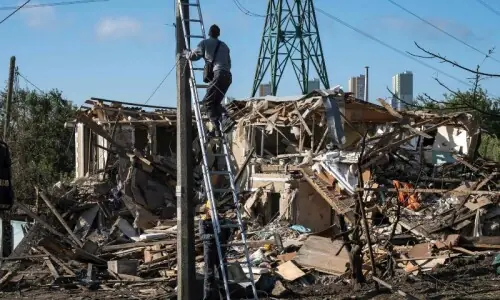
PARIS: European nations have pumped billions into defence spending and military aid since Russia’s invasion of Ukraine, but analysts say the continent’s defence industry is still far from able to supply Kyiv alone.
About $44.5 billion in arms have flowed from the United States to Ukraine since Russian tanks rolled in on Feb 24, 2022.
But Washington’s failure to agree to a new tranche of support and the potential re-election of Donald Trump to the White House in November could leave it up to Europe to plug a vast gap.
The EU’s spending on aid has totalled 28 billion euros ($30 billion) over two years, with a further 20 billion planned this year, according to the bloc’s top diplomat, Josep Borrell.
German Chancellor Olaf Scholz has nevertheless urged allies to “do more”.
Individual member states have upped defence spending, with France’s President Emmanuel Macron even talking of a “war economy”.
But just nine of the 27 member states spent more than Nato’s nominal floor of two percent of GDP on defence last year.
Germany, France and Italy — the EU’s wealthiest countries, with world-class defence industries — were not among them.
“European countries have not massively increased their budgets since the invasion of Ukraine, and they haven’t been ordering much either” from manufacturers, said Renaud Bellais, an economist specialising in the defence industry.
Fragmented
Production lines are rolling out equipment, including anti-aircraft and anti-tank missiles, shells and cannons, whether heading for Ukraine or rebuilding depleted national stockpiles.
The EU has fallen short of an initial goal to ramp up production of critical 155mm artillery shells, but expects to build 1.4 million of them in 2025 — 200,000 more than the US plans.
“European production capacity isn’t so negligible, but it’s quite fragmented -- for instance, 15 shell manufacturers spread across 11 countries — and not at all coordinated,” Bellais said.
Meeting Ukrainian demand “will take time, because we haven’t got organised to do it”, while actually building military equipment can take “several months or even years”, he added.
“Currently the European defence and technology-industrial base is not able to meet wartime demands,” analyst Christian Moelling of German think tank DGAP wrote in a recent note.
Published in Dawn, February 13th, 2024