China set to launch high-stakes mission to moon’s ‘hidden’ side


China will send a robotic spacecraft in the coming days on a round trip to the moon’s far side in the first of three technically demanding missions that will pave the way for an inaugural Chinese crewed landing and a base on the lunar south pole.
Since the first Chang’e mission in 2007, named after the mythical Chinese moon goddess, China has made leaps forward in its lunar exploration, narrowing the technological chasm with the United States and Russia.
In 2020, China brought back samples from the moon’s near side in the first sample retrieval in more than four decades, confirming for the first time that it could safely return an uncrewed spacecraft to Earth from the lunar surface.
This week, China is expected to launch Chang’e-6 using the backup spacecraft from the 2020 mission and collect soil and rocks from the side of the moon that permanently faces away from Earth.
With no direct line of sight with the Earth, Chang’e-6 must rely on a recently deployed relay satellite orbiting the moon during its 53-day mission, including a never-before-attempted ascent from the moon’s “hidden” side on its return journey home.
The same relay satellite will support the uncrewed Chang’e-7 and 8 missions in 2026 and 2028, respectively, when China starts to explore the south pole for water and build a rudimentary outpost with Russia. China aims to put its astronauts on the moon by 2030.
Beijing’s polar plans have worried NASA, whose administrator, Bill Nelson, has repeatedly warned that China would claim any water resources as its own.
Beijing says it remains committed to cooperation with all nations on building a “shared” future.
On Chang’e-6, China will carry payloads from France, Italy, Sweden and Pakistan, while Chang’e-7 will bear payloads from Russia, Switzerland and Thailand.
NASA is banned by US law from any collaboration, direct or indirect, with China.
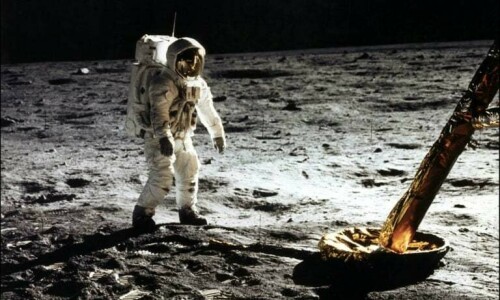
Under the separate NASA-led Artemis programme, US astronauts will land near the south pole in 2026 — the first humans on the moon since 1972.
“International cooperation is key [to lunar exploration],” Clive Neal, professor of planetary geology at the University of Notre Dame, told Reuters. “It’s just that China and the US aren’t cooperating right now. I hope that will happen.”
South Pole ambitions
Chang’e-6 will attempt to land on the northeastern side of the vast South Pole-Aitkin Basin, the oldest known impact crater in the solar system.
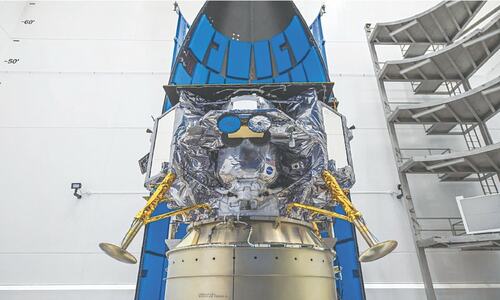
The southernmost landing ever was carried out in February by IM-1, a joint mission between NASA and the Texas-based private firm Intuitive Machines.
After touchdown at Malapert A, a site near the south pole that was believed to be relatively flat, the spacecraft tilted sharply to one side amid a host of technical problems, reflecting the high-risk nature of lunar landings.
Scientists have described the south pole as the “golden belt” for lunar exploration. Polar ice could sustain long-term research bases, without relying on expensive resources transported from Earth.
India’s Chandrayaan-1, launched in 2008, confirmed the existence of ice inside polar craters.
Chang’e-6’s sample return could also shed more light on the early evolution of the moon and the inner solar system.
The lack of volcanic activity on the moon’s far side means there are more craters not covered by ancient lava flows, preserving materials from the moon’s early formation.
So far, all lunar samples taken by the United States and the former Soviet Union in the 1970s and China in 2020 were from the moon’s near side, where volcanism had been far more active.
Chang’e-6, after a successful landing, will collect about 2 kilogrammes of samples with a mechanical scoop and a drill.
“If successful, China’s Chang’e-6 mission would be a milestone-making event,” Leonard David, author of Moon Rush: The New Space Race, told Reuters. “The robotic reach to the Moon’s far side, and bringing specimens back to Earth, helps fill in the blanks about the still-murky origin of our Moon.”