Pakistan is a massive country of over 225 million souls, and with a fifth-gear population growth rate of 2.55 per cent per annum, it faces the grim task of feeding its population.
The country is also one of the top ten countries with climate change risk in the world. The economy is precarious and, with one of the highest GDP-to-public debt ratios in the world, faces the daunting task of rebuilding its ageing agriculture sector, most notably its irrigation and drainage infrastructure.
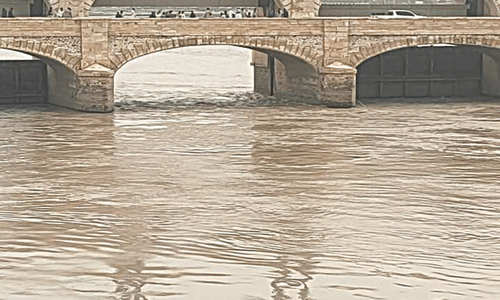
In June this year, one of the gates of Sukkur barrage collapsed during active inundation season, and it is miraculous (and to the credit of the Sindh Irrigation Department) that the province was able to avoid the worst as supplies to its seven off-taking canals were restored within three weeks. This curtailed the devastating impact on rice and cotton crops during peak demand.
The current year 2024-25 budget has shown that the country has hardly any spare cash for investing in infrastructure for agriculture and ensuring its food security in the coming years and decades. Global warming is no longer a threat to the future; it has manifestly arrived.
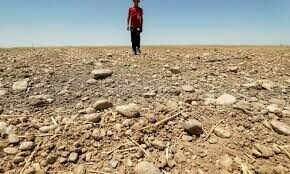
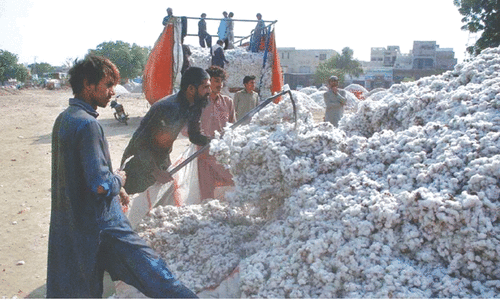
The excessive heat has decimated cotton and severely impacted paddy crops, and farmers in Sindh and Punjab are going to suffer massive losses to the tune of hundreds of billions of rupees when crop yields are reported later this year. The wheat debacle of 2024 is still raw, and farmers, most notably in Punjab, have not yet recovered from their losses.
Real Estate Investment Trusts are a potential model the government and the private sector can use to invest in agriculture
The issue is that when a major chunk of Pakistan’s revenue is utilised for debt servicing, defence, and meeting current expenditures to run the government, the state has no fiscal space for undertaking infrastructural development projects.
We often say we need the private sector in development, including in the agriculture sector, but we have to define what we mean by the private sector and what business models can be used if they were to find agricultural infrastructure an area of investment interest.
Real Estate Investment Trusts (REITs) are a potential model the government and the private sector can use to undertake investment in agriculture, including irrigation and drainage. This will require a proper policy framework from the government.
The government will have to provide incentives such as tax breaks with a premium on foreign investment. The Special Investment Facilitation Council (SIFC) must consider that its current strategy of land-based expansive development will take it nowhere.
Already, many questions are being asked about bringing “millions of acres of barren land” under cultivation, and the recent noise over the Indus River System Authority amendment has caused friction in the ruling set-up.
Sindh is already and rightly up in arms. Bringing new areas under irrigation — what Professor Ian Carruthers called desert bloom syndrome — would be a sure-shot failure of the Green Pakistan Initiative.
We must understand that freshwater — not land — is the constraining factor for the agricultural development of Pakistan. The SIFC must understand this detail and study the nature of Pakistan’s infrastructural needs. It must also work with credible and known Pakistani business houses to create a synergy with existing farmers.
The government, on its part, should provide long-term tax relief on the REITs pattern (though REIT companies beg for concession renewals before every budget). The REIT agricultural irrigation and drainage projects could be canal command (or barrage) based and should undertake market-based investments in water conservation, like canal lining, and charge farmers (who are consumers of irrigation service) for improved irrigation service.
The Provincial Irrigation and Drainage Acts of 1997 not only allows but stipulates that the government comes out of irrigation expenses and full costs to be recovered from farmers for irrigation and drainage services.
This should be coupled with doing away with price suppression of farm produce as farmers would not be able to pay for world-class irrigation service if prices of farmer produce continue to be suppressed.
REITs can and should undertake processing and value addition with cold-chain facilities, preferably in areas where local production during peak season is in excess and farmers can access it. Farmers may sell their produce to the processing company or may use the processing company’s service to sell the value-added product in the local market or export it.
The second major directional change is doing away with minimum export price (MEP) for agriculture exports. This is a major barrier, and the arbitrary nature of fixing MEP makes Pakistani basic produce like potatoes, onions and tomatoes unviable for even rich markets like Dubai.
Without doing away with price suppression and ending export controls, Pakistan’s agriculture would continue to be mired in low-value and perennial food insecurity at home. For REITs to work in agriculture, policies would require both pull and push efforts from the business sector and the government.
The writer is a retired secretary of forest and wildlife in Sindh and a hands-on farmer.
Email: aijazniz@gmail.com
Published in Dawn, The Business and Finance Weekly, October 14th, 2024