ISLAMABAD: A renewed call to make public the proceedings of the Judicial Commission of Pakistan (JCP), under the leadership of Chief Justice of Pakistan (CJP) Yahya Afridi, has once again been rejected — reopening a debate previously settled by the commission during a meeting last year.
In the Nov 25, 2024 meeting, senior puisne judge Justice Syed Mansoor Ali Shah had proposed that the minutes of JCP meetings be made public, but the idea was turned down by a majority of members, a well-placed source revealed.
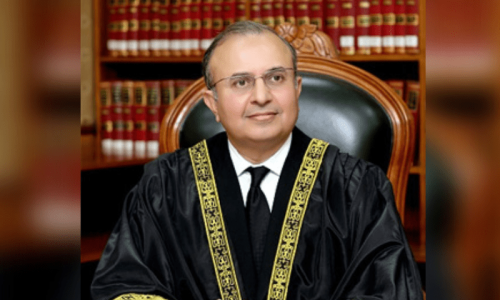
On June 25, Justice Shah again urged the JCP to share minutes of its meetings — citing past transparency measures taken during the tenure of former CJP Justice Qazi Faez Isa, when the minutes of a three-judge committee formed under the Supreme Court (Practice and Procedure) Act 2023 were regularly uploaded on the Supreme Court’s official website.
The Nov 25 JCP meeting had been convened to constitute a nine-judge constitutional bench for the Sindh High Court, which was approved by a majority vote of 11 to 4. However, PTI representatives — Leader of the Opposition in National Assembly Omar Ayub and Leader of the Opposition in Senate Shibli Faraz — did not attend the meeting.
The JCP waited for nearly two hours for the two members to arrive, but their mobile phones remained switched off. The commission then proceeded with its meeting. Later, PTI Chairman Barrister Gohar Ali Khan and Senator Barrister Syed Ali Zafar were nominated to replace Omar Ayub and Shibli Faraz in the JCP.
During the session, chaired by CJP Yahya Afridi, Justice Shah invoked Article 19A of the Constitution to argue that the proceedings of the commission should be made public due to the significant public interest involved in its decisions. He emphasised that transparency in judicial appointments was essential to uphold democratic norms and public trust.
Law Minister Tarar responded that the decision should be based on the collective wisdom of the commission’s members.
AGP Awan noted that the in-camera nature of JCP meetings was prescribed by the commission’s rules of 2010 and that any deviation would require a formal amendment to those rules.
The CJP clarified the current legal framework did not allow disclosure of proceedings, as the existing rules explicitly prohibit it. Nevertheless, he put the matter to a vote.
The proposal was rejected, with 11 members voting against it and only three — including Justice Mansoor Ali Shah and Justice Munib Akhtar — voting in favour. SHC Chief Justice Shafi Siddiqui abstained.
In a fresh letter, Justice Shah reiterated his concern, stating that the opacity surrounding the commission’s working was neither healthy nor democratic and was inconsistent with the Supreme Court’s role as the guardian of constitutional values. He underscored that judicial appointments are acts of public significance with far-reaching consequences.
Published in Dawn, July 5th, 2025