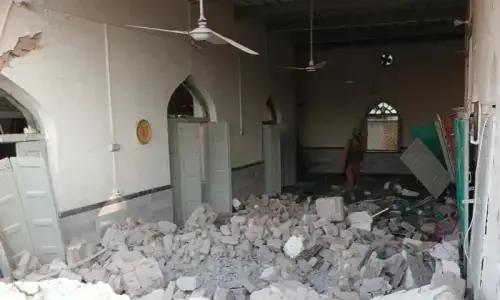
THE cold, hard truth when it comes to Pakistan’s industrial terrain is that for far too many workers, the workplace is a death trap. The recent tragedies in Faisalabad, where a gas explosion at a glue factory killed at least 20 people, and in Hyderabad where a deadly fireworks factory blast claimed at least 10 lives, are not one-off events. They form part of a pattern in which safety rules are ornamental, enforcement is lax, and accountability beyond the news cycle is rarely witnessed. In Faisalabad, a pre-dawn gas leak triggered an explosion so powerful that an entire cluster of factories collapsed and nearby homes were damaged. Rescuers spent hours pulling bodies from the rubble. Early confusion over whether a boiler had exploded points to a familiar chaos that follows such disasters. Regardless, the fact is that factories were operating in unsafe, congested conditions, and workers paid with their lives. Hyderabad’s catastrophe is no less shocking. Fireworks were being manufactured illegally inside a house in Latifabad, with explosive materials hidden in a tunnel-like structure. The owner reportedly held a licence for another location. The blast was heard miles away. While some workers died instantly, several others were left with major burns.
As authorities piece together the remains and DNA tests identify bodies, the scale of negligence becomes clearer. The subsequent district-wide orders to seal illegal fireworks units and relocate LPG shops show that the authorities knew the risks long before the explosion. Sadly, action came only after lives were lost. Such negligence is tragically familiar. The Baldia factory fire in 2012, which killed more than 260 workers, should have transformed Pakistan’s occupational safety regime. Instead, more than a decade later, factories still lack basic fire exits, inspections are sporadic at best, informal workshops operate inside residential neighbourhoods, and labour departments remain understaffed and politically sidelined. The government must do far more than order inquiries and issue compensation cheques. Pakistan needs a harmonised workplace safety law, mandatory third-party audits for high-risk industries, unannounced inspections backed by real penalties, and relocation of hazardous units outside populated areas. Safety must become non-negotiable. Until the state values workers’ lives as much as industrial output, such tragedies will continue, and every charred building will bear witness to official neglect.
Published in Dawn, November 22nd, 2025