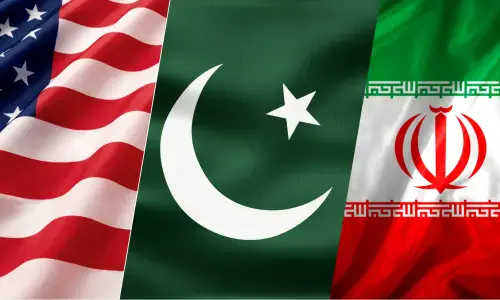

ONE year after the tragic attack in Pahalgam in occupied Kashmir, India would have liked to be living in a different global reality. It would have liked to have Pakistan globally isolated. It would have liked to be exercising the prerogatives of a regional hegemon in South Asia. It would have liked to be celebrated as the world’s biggest fighter of terrorism even though, as Pakistan’s Information Minister Ataullah Tarar pointed out, it “has not presented any solid evidence or proof regarding the Pahalgam incident, nor has it offered satisfactory explanations”. None of these things has happened. Pakistan is being celebrated as a peace broker in a gnarly conflict, India has become regionally sidelined in the midst of a major conflict in West Asia, and New Delhi’s support for terrorist activity in Pakistan has not gone unnoticed.
So India is doing what India does best under Modi — pretending that it lives in the reality it desires rather than the reality that exists. Speaking on April 22, 2026, the anniversary of the attack, BJP leaders spoke as if Operation Sindoor — launched without providing proof of an alleged Pakistan connection — was the best decision in India’s history. Indian Defence Minister Rajnath Singh came out with the sort of bluster typical of Indian foreign policy. He said: “If you look at the history of India, to date, India has not attacked any country in the world from its own side. But the one who is powerful does not attack anyone. But if a neighbour tries to create trouble, then dot, dot, dot… All neighbours are fine, only one is troublesome.” He also insisted the Indian military had, because of Operation Sindoor, “become stronger than before”. As in the case of allegations linking Pakistan to Pahalgam, he provided no proof.
What may be interpreted as bombast goes against the reality of April 2026 and are the feeble remonstrations of a child whose tantrum has failed but continues anyway. Even if Pakistan’s diplomatic interventions in quelling a conflict that threatens Global South economies are disregarded, India has failed to protect its own interests. As sections of the Indian media — essentially a propaganda arm of the Modi administration — decried Pakistan’s rise, the country itself, which relies heavily on foreign fossil fuels, is teetering. Facing elections, the Modi administration has kept fuel prices low, but this will likely end once polls are completed. This threatens inflationary shock when prices begin to reflect oil costs. Indian ships remain stuck in the strait, and some have reportedly even come under fire from Iran.
As has become typical for the Modi administration, the response has been to clamp down on news of these possibilities rather than contend with reality. Changes to digital media laws will further suppress YouTubers and social media users. These independent sources — which have emerged because much of the mainstream Indian media has become known for rabid and questionable assertions — will now also be harassed, threatened and jailed for daring not to toe the Modi line. In the words of Amnesty International’s India director: “These amendments go further still, effectively turning social media platforms into enforcement arms of the state … and pave the way for mass and prolonged surveillance.”
Denying reality is the cornerstone of India’s worldview.
All of this is deemed necessary because denying reality has become the cornerstone of the Indian worldview under Modi. And it works — even as Pakistan is trying to intervene in a conflict that threatens the world, Indians are busy watching Dhurandar 2 and converting Bollywood fantasies into the realities of their politics and foreign policy. In Pahalgam itself, life remains tense. One Indian reporter noted that the government’s harassment of local people is endless, with families of long-dead alleged militants harassed daily. Tourists are few, mostly because so many restrictions have been imposed on where guides can and cannot take them — a problem in an area whose draw is its pristine beauty.
The outcome of Pahalgam and the ill-fated Operation Sindoor, which ended in global humiliation for New Delhi, is that India has retreated from the world stage to the safety of its home theatre where it can watch Bollywood versions of reality on repeat. The complexities of war and peace, of economic costs and food insecurity, all seem too taxing to process. When US Vice-President J.D. Vance landed at the Nur Khan Air Base in Rawalpindi, it underscored how untrue Indian claims of its destruction had been. Defeat, of course, is not always surrender; it also means retreat and, faced with unpleasant truths, that is what India has chosen.
The writer is an attorney teaching constitutional law and political philosophy.
Published in Dawn, April 25th, 2026