

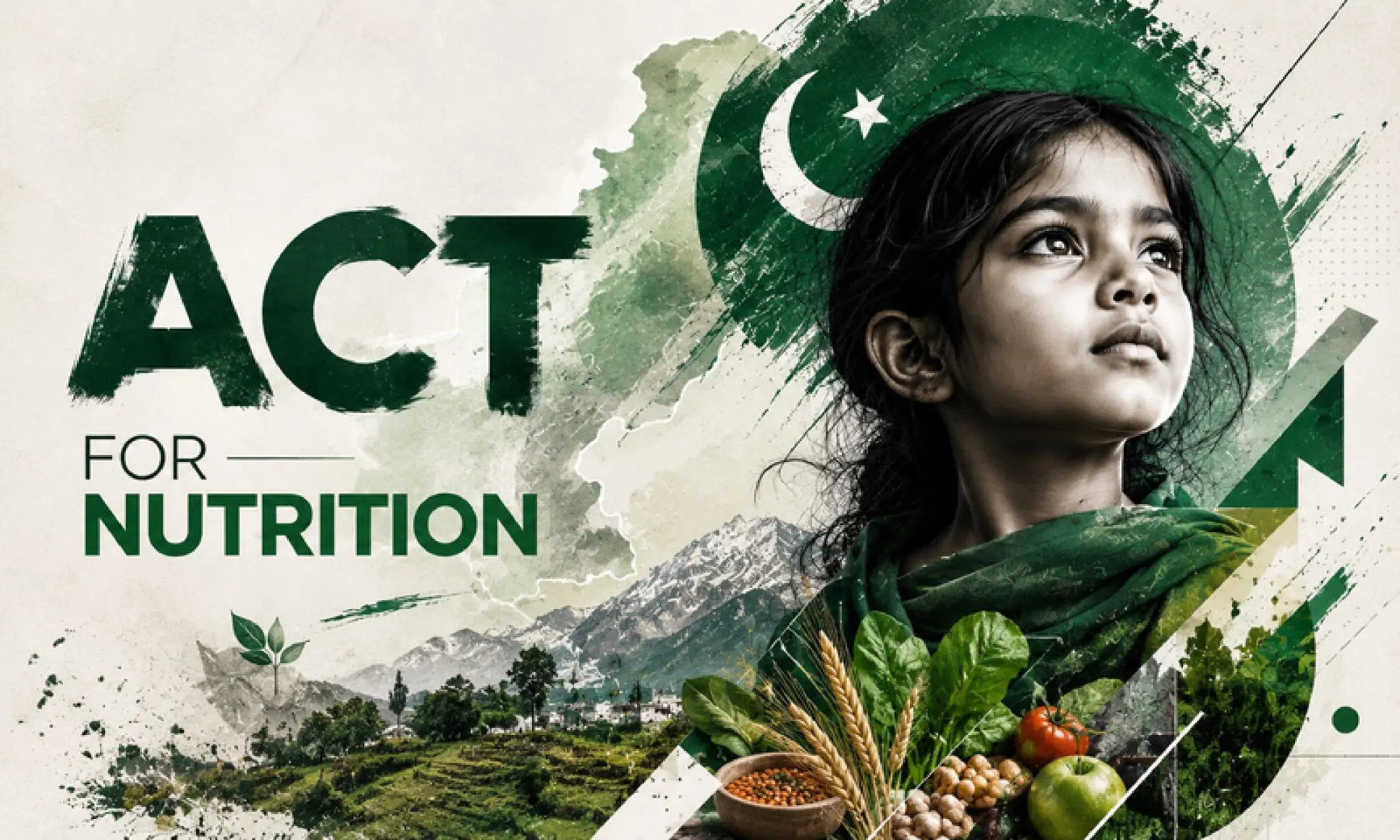
Investing in people: nutrition moves to the centre
There is a quiet significance in the fact that Prime Minister Shehbaz Sharif is opening the ACT For Nutrition conference at the Serena Hotel this week, alongside the Director-General of the World Health Organisation and the Unicef Representative in Pakistan. Heads of government do not usually open conferences on child stunting. That they are doing so here reflects a shift that has been underway in Islamabad for some time: nutrition has moved out of the health column and into the national economic plan.
A doctrine, not a gesture
That shift has a name. URAAN Pakistan, the National Economic Transformation Plan launched by the Prime Minister at the end of 2024 and anchored in the 13th Five-Year Plan, is built around five pillars, of which Equity, Ethics and Empowerment is one. The plan directs a substantial share of a multi-trillion-rupee public investment envelope towards the social sectors, a deliberate reweighting away from decades of infrastructure-first budgeting.
Federal Minister for Planning, Development and Special Initiatives Ahsan Iqbal has been unusually direct about the reasoning. He has described malnutrition, and stunting in particular, not merely as a health issue but as a matter of national security, and has argued that the coming era will be decided by brain power and capability, which a stunted child cannot supply. He has also spoken of shifting development priorities from conventional brick-and-mortar projects towards investment in people.
This is a meaningful piece of political framing, and it deserves to be recognised as such. Governments in Pakistan have historically found it far easier to inaugurate a building than to fund a supplementation programme, because one produces a photograph and the other produces a statistic ten years later. Choosing the statistic is a harder political decision, and this government has made it in public.
The Prime Minister set the direction earlier, chairing a high-level meeting with international experts on child malnutrition and directing that a national programme be developed in collaboration with the provinces. That instruction, that this be done federally but with provincial ownership, is the correct architecture for a devolved subject, and it is the architecture the Pakistan Nutrition Pact is now positioned to formalise.
Financing that has actually been delivered
Doctrine is cheap. Money is not, and this is where the government’s record is strongest.
The Benazir Nashonuma Programme, delivered through BISP with technical support from the World Food Programme, Unicef and WHO, is now described as the largest government-funded programme in WFP’s global history. The federal government committed some $194
million to it under the 2024-26 agreement alone, bringing total government investment to close to half a billion dollars. In a period of acute fiscal consolidation, under an IMF programme, with every ministry under pressure to cut, the government protected a nutrition programme and then expanded it.
The results have justified that decision. The independent midterm evaluation by Aga Khan University’s Institute for Global Health and Development recorded stunting prevalence 6.4 percentage points lower among participating children, with those enrolled around 22 per cent less likely to be stunted by six months of age, alongside a 5.6 percentage-point fall in low birth weight in intervention districts. WFP has characterised these as among the strongest results documented globally for a large-scale nutrition programme.
In July this year the programme was extended for a further three years, adding 3.3 million women and children and taking cumulative reach towards eight million people through 578 facilitation centres and 224 stabilisation centres across 158 districts. Very few governments in Pakistan’s income bracket have scaled a nutrition intervention this far on their own resources.
The federal budget for 2026-27 tells a consistent story: Rs53.3 billion for health-related spending, with Rs24.3bn under the PSDP for health and nutrition, against an initial Rs16.5bn the previous year. The trajectory is upward at a time when very little else is.
Credibility abroad, converted into resources
The government’s diplomatic work has translated into money as well. Pakistan secured a ten-year Country Partnership Framework with the World Bank covering FY2026 to FY2035, worth around $20 billion, the Bank’s first partnership of that length with the country.
Reduced child stunting, through clean water, sanitation, basic health, nutrition and family planning, is listed as the first of its six objectives.
That ordering is not incidental. It reflects a negotiating position taken by Pakistani officials, and it means that a decade of concessional financing is now formally hitched to the same indicator the Prime Minister will speak about this week.
The questions worth asking on the floor
A conference is most useful when it converts commitment into design. Four questions would repay the Prime Minister’s attention.
Federal-provincial machinery. Nutrition is devolved, and the federal government’s role is convening rather than commanding. What standing forum will carry the Pact forward between conferences, and how often will it meet in public?
Fortification harmonisation. Sindh, Balochistan and Khyber Pakhtunkhwa have all legislated mandatory food fortification. Because flour moves across provincial borders, national standards and a supported premix supply chain would let millers compete on level terms. What federal instrument would best deliver that, and what would help Punjab complete its own process?
A traceable nutrition line. Nutrition spending is currently distributed across health, agriculture, education, water and social protection, which reflects the problem’s real shape but makes the total hard to state. Would a consolidated annexure in federal and provincial budgets help ministries demonstrate what they are already spending?
A current baseline. The National Nutrition Survey 2018 remains the backbone of every plan written since, and it has served eight years across two flood cycles. Commissioning the next round would allow this government to measure, and claim, what it has achieved.
The opportunity
Bangladesh, Peru, Senegal and Rwanda all brought stunting down substantially, and none of them did it through a single intervention. They did it through sustained political leadership over a decade, applied to unglamorous delivery. The variable was never technical knowledge. It was whether the head of government kept caring after the launch event.
Pakistan now has the delivery platform in Nashonuma, the legislative base in three provinces, the financing framework with the World Bank, a national plan that names human capital as the objective, and a Prime Minister willing to open a conference on child stunting in person. The Pakistan Nutrition Pact, launched on Wednesday, is the instrument that can tie those together into commitments with dates attached.
The children this will decide for are being born this week. The groundwork has been laid; what remains is to hold the course.
This content is produced in paid partnership with the Government of Pakistan - a partner of DawnMedia’s Act for Nutrition initiative.