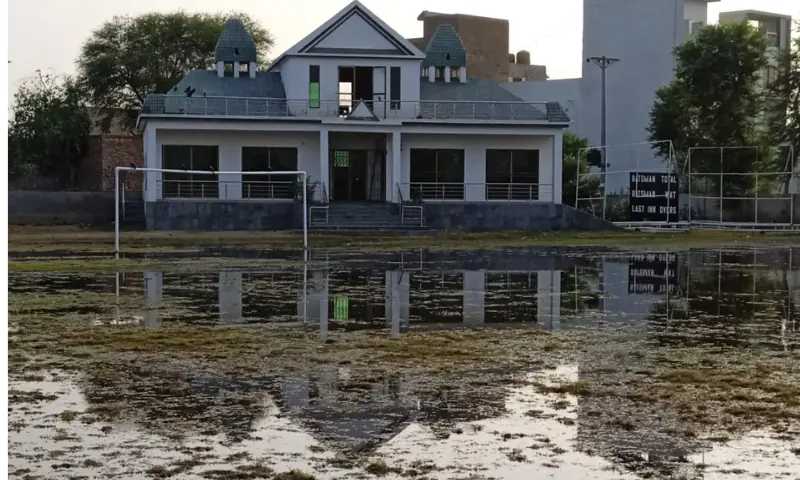
Cricketer Ali Usman's home turf in Gaggoo Mandi is falling silent
When Ali Usman returned home to Gaggoo Mandi after making his Pakistan Test debut against the West Indies in August, hundreds of people gathered at the ground to welcome him. For a few hours, the place looked the way it once did — full, loud, alive with the town’s pride in one of its own.
That kind of gathering has become a rarity here.
“After a very long time, so many people have gathered at this ground,” said Arslan Kashif, a 20-year-old right-handed batter who plays for the same club and was among those who came to welcome Ali.
“I had only heard stories about how busy it once was, how many people came here and how much sport was played.”
Not so long ago, this ground didn’t need a homecoming to fill up.
“There was a time when 40 to 50 young boys would come to play cricket here, not just from this town but from surrounding villages as well,” said Mehmood Niaz, the club’s president, who watched Mohammad Zahid, Mohammad Irfan and Ali all come through in their club years.
“Now, I struggle to find even 11 players to field a team.”
Ali’s Test debut was not merely the realisation of his lifelong dream of becoming a Test cricketer, but also the fulfilment of a collective dream shared by everyone who had watched his journey unfold from the very beginning.
I remember Ali as a teenager, practising his left-arm spin whenever I returned home from university. We played on the same ground he was welcomed back to. I had a standing offer: if he got me out, I would buy him a treat. Our running joke was that he never managed it — or, if he did, I refused to accept the umpire’s decision.
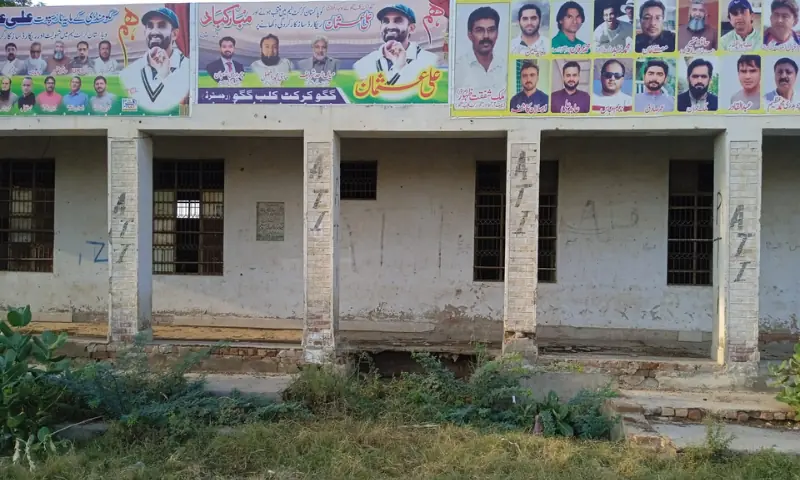
After his debut against the West Indies, Ali played two Tests in England. At Headingley, he took his first five-wicket haul, finishing with five for 92 — the first visiting spinner in 54 years to take five wickets in a Test innings at the ground, following Australia’s Ashley Mallett, who took five for 114 in 1972.
His Pakistan appearance made him the third Test cricketer from my hometown, Gaggoo Mandi. Ali succeeded Mohammad Zahid, the fast bowler Brian Lara described as one of the quickest he had faced, and Mohammad Irfan, the tallest cricketer to represent Pakistan in Test matches. All three began their journeys on the ground where I spent my club cricket years.
That made Ali’s homecoming a proud occasion. But it also drew attention to what has happened to the club that helped produce him. Despite producing three Test cricketers and many first-class and Grade-II players, Gaggoo Cricket Club now struggles to field a team for local matches.
“Ali playing Test cricket for Pakistan is a moment of immense pride for me and the entire city,” Mehmood said. But he rued the declining interest in the sport, which has left what was once a ground always crowded by ambitious cricketers almost empty.
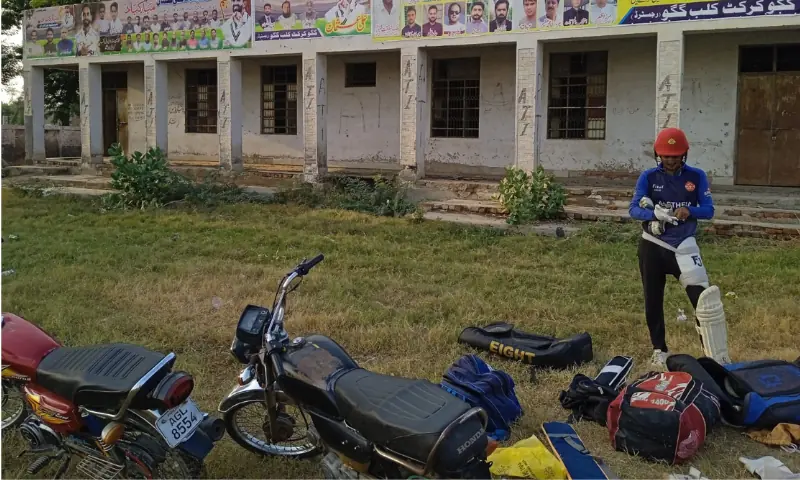
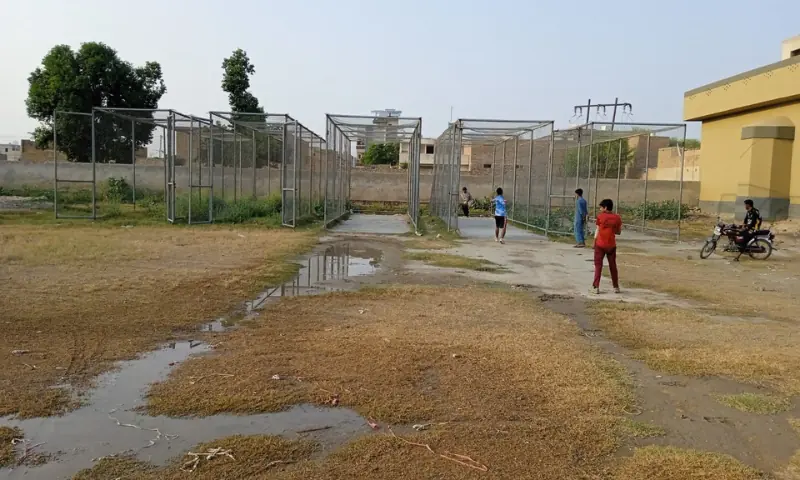
The exodus has been fueled by rising charges to access the ground since the Sports Board Punjab took it over. Before that, according to Mehmood, it was the players alone who built, maintained and watered the ground. Now those same players can hardly afford to play on it.
“If you want to play a match on this ground on Sunday, you have to pay a ground fee of Rs25,000,” Mehmood said.
“On Friday, it is Rs10,000, and even on ordinary weekdays, it is Rs2,500. Amid rising inflation, when buying even one or two balls has become difficult for us, how will these children arrange that kind of money to play?”
Khalid Naseem spent much of his cricketing life caring for the ground, driven by nothing but his love for the game. He used to wake in the middle of the night to water it, prepare the pitches and maintain the field, all without pay.
“I worked literally as the groundsman on this ground, simply because I wanted to play cricket and follow my passion,” he said.
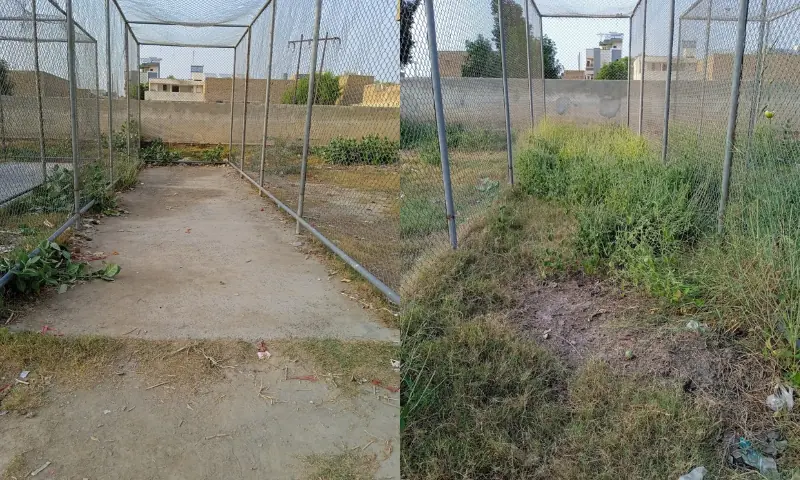
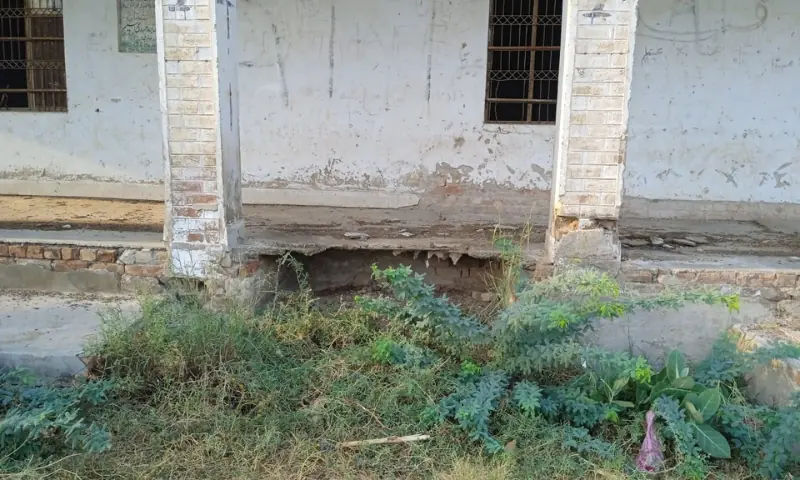
He now works as a pitch curator at the PCB’s High Performance Centre in Sialkot — his own playing dream long gone. Whenever he returns home and visits the ground, he finds overgrown grass, neglected nets and abandoned pitches.
“It hurts to step into this ground now,” he said, echoing Mehmood’s memory of a field once filled with footballers as well as cricketers.
“Few boys are still seen with a football here,” he said, “but young cricketers have vanished.”
Khalid believes young people have also lost the inspiration his generation found in Pakistan’s leading players.
“Back when we played, we had icons like Imran Khan, Javed Miandad, Wasim Akram, Waqar Younis and Inzamamul Haq,” he said.
“Watching them inspired us to work hard and achieve something. That determination produced players like Mohammad Zahid, Mohammad Irfan and now Ali Usman. But when I look at the situation in Gaggoo Mandi today, I do not see the same interest in cricket or hope for its future.”
For Arslan, Ali’s success is proof that hard work can still take a young player from this ground to international cricket.
“Ali Usman is my inspiration,” he said.
“Seeing what he has achieved gives me the belief that anything is possible through hard work. It motivates me to follow in his footsteps and achieve something that will make my city and my club proud of me.”
But for players like Arslan to follow that path, they need affordable places to play, regular club cricket and proper facilities. Without these, the club that once served as a nursery for international cricketers may struggle to produce its next generation.
Nadeem Iqbal, another club member, played more than 80 first-class matches. Playing for Pakistan Customs, he once took six for nine as National Bank of Pakistan were bowled out for 20, setting a domestic record.
Years later, Ali matched those figures for Pakistan Television against Sui Northern Gas Pipelines, taking six for nine while defending a target of 40 runs — two remarkable spells, a generation apart, from players who learned their cricket on the same small-town ground.
“I played alongside legends such as Wasim Akram, Waqar Younis, Javed Miandad and Saleem Malik,” Nadeem said.
“When I returned from first-class or English county cricket, I had endless stories to inspire these children. Back then, youngsters saw stars and dreamed of following in their footsteps.”
He believes the Pakistan Cricket Board (PCB) must do more to support clubs.
“The PCB must urgently step in and support club cricket,” he said.
“It is the ultimate nursery, and without it, grassroots cricket cannot survive.”
This decline at the grassroots level mirrors the wider problems facing Pakistan cricket, which came under fierce criticism after a 3–0 Test series defeat in England. Pakistan continues to produce raw talent, but the system is failing to nurture it.
The crisis is visible even in Islamabad, where I now live for my work as a journalist. I still visit local grounds and play cricket whenever I can, which has let me observe the same problems up close.
Young players in the capital face limited access to facilities and increasingly unaffordable costs. Some of the city’s best grounds, National Cricket Ground and Diamond Cricket Ground, are controlled by the PCB and largely unavailable for local club matches — forcing clubs and young players to rent private grounds while also paying for expensive equipment.
Renting a ground for a single club match in Islamabad can cost between Rs10,000 and Rs15,000 on a weekday, rising to between Rs20,000 and Rs30,000 at weekends. At these prices, it is extremely difficult for young cricketers and local clubs to organise matches regularly.
It is not too late to prevent Pakistan cricket from following the disastrous path of the country’s national hockey team. But urgent structural reform is needed, and grounds and training facilities must be made accessible.
Pakistan does not lack talent. Ali Usman’s journey from a ground in Gaggoo Mandi to a historic five-wicket haul at Headingley proves that Arslan Kashif and many other young cricketers could become Pakistan’s next stars. Talent alone, though, is not enough.
The writer is a journalist based in Islamabad and has been in the media industry since the last 18 years.