

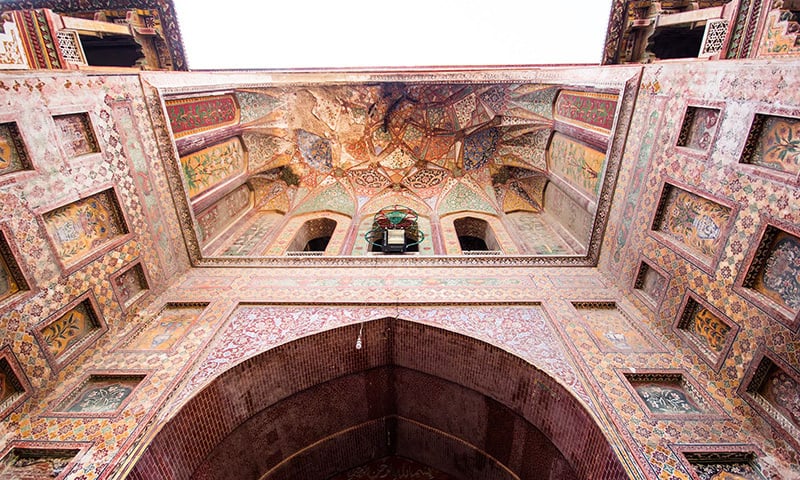

Our heritage sites are key to safeguarding a shared national identity and cultural legacy, but they are withering away.
Cultural heritage sites in Pakistan tell a poetic tale of the history of this land, which goes well beyond its inception in 1947. They're an emblem of our cultural diversity and national identity, and with their unparalleled architectural beauty, are invaluable and, by all means, irreplaceable.
It is appalling and deplorable, however, that the majority of these historical treasures are in a rather sorry state, mostly due to neglect and vandalism, but also due to terrorism, which has led to the destruction of many historical remains.
Consequently, several of these ruins are now too fragile to endure harsh weather, sunlight, floods and other natural disasters.
Hence, their preservation poses a challenge that needs to be addressed urgently.
See: Rs29m restoration work on Ghulam Shah Kalhoro mausoleum gets under way
Fortunately, technological breakthroughs have now allowed us to seek alternatives when it comes to saving our legacy. Today, all around the globe, laser scanners are being used to create 3D models which will digitally restore monuments and artefacts to their current conditions, and make these models available to people all over the world.
This remarkable mode of preservation is now being implemented in Pakistan as well, thanks to the joint efforts of the Lahore University of Management Sciences (Lums) and CyArk (an international non-profit organisation that offers expertise toward digitally storing heritage before they are damaged beyond repair).
Dr Murtaza Taj, Assistant Professor at Syed Babar Ali School of Science & Engineering (SBASSE), Lums and Principal Investigator of the project, along with his team, has initiated research activities including scanning of monuments and testing and analysis of different approaches. The project is funded primarily by the US Agency for International Development (USAID) through the US Ambassador’s Fund Program, a 7-year program which aims to support high impact projects in Pakistan such as cultural preservation.
 |
| Dr Murtaza Taj working on site in Lahore. |
 |
| A monument being digitally preserved. |
Besides the preservation itself, spillover from this project could help train Pakistan's human resource in properly preserving cultural sites. Transferred further on, the skills imparted could have a countrywide impact on overall heritage protection in Pakistan.
Currently, digital preservation is underway for several historical monuments in Sindh, Punjab and Khyber Pakhtunkhwa.
Masjid Wazir Khan in Lahore – the Mughal era remnant with two gates, minarets, and walls emblazoned with Arabic calligraphy and Qashani work – is one such example, where aesthetic brilliance will be completely preserved through the digital medium.
Also read: A visual delight – Maryam Zamani and Wazir Khan Mosques
Situated in Dadu, Sindh, is the Jamia Masjid Khuda Abad; the mosque is a monumental site with a splendid history which is evident from its quaint style, elaborate designs and distinct calligraphy. Nonetheless, the slow disintegration of the mosque’s longstanding structure is now noticeable. Preservation work is in progress there.
Then there is the majestic Derawar Fort in Bahawalpur, Punjab, its walls rising up to 30 metres. Once a very impressive structure, the fort has been vandalised in the past and is now slowly eroding away; its once darksome underground passageways now sun-drenched as a result of the roof falling to ground.
 |
| Team working on site. |
 |
| Group photo of the project team. |
For these and many other sites, such as Takht-i-Bahi, the ruins at Jaulian, the Temple of Shiva and so on, there is hope for survival through 3D digital preservation, which will not only store their model but make them available to a wider audience online.
As inheritors of a wealth of cultural heritage, this is good news.
One hopes that initiatives like these have a ripple effect and that eventually, all monument sites in Pakistan, small or big, are conserved in the best way possible. Preserving the past is the way to safeguarding our distinctiveness and traditional legacy as a nation.





























