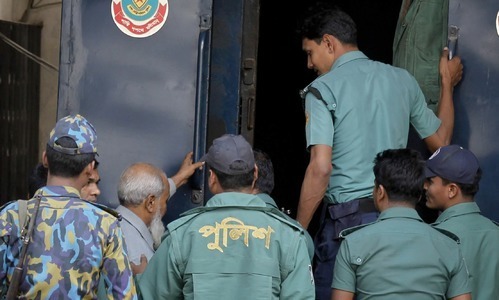
ISLAMABAD: The Foreign Office on Friday expressed concern over the dismissal of Bangladesh Jamaat-i-Islami chief Motiur Rehman Nizami’s final appeal against death sentence awarded to him by a controversial war crimes tribunal for his involvement in 1971 events.
“We have noted with deep concern and anguish the dismissal of the review application on the death sentence by the Supreme Court of Bangladesh for Mr Motiur Rehman Nizami, the leader of Jamaat-i-Islami,” a statement said.
“We have also been following the reaction of the international community and human rights organisations to the controversial trials in Bangladesh, related to events of 1971,” the FO further said.
Dismissal of Mr Nizami’s appeal by Bangladesh’s top court has paved the way for his execution and the only option left with him is to seek clemency.
Mr Nizami’s party has called for protests against the rejection of his appeal.
Motiur Rehman Nizami awarded death sentence for his involvement in 1971 events
Pakistan’s reaction to the court’s decision could add to strains in bilateral ties. Reaction from Pakistan to executions and sentencing in the past evoked strong reaction from Dhaka.
The trial of people accused of ‘war crimes’ during the 1971 war has been a major irritant in the bilateral ties.
Four politicians, most of whom were associated with the JI, have so far been executed after they were convicted by war crimes tribunals set up by Hasina Wajid’s government in 2009. Another accused died while his appeal against conviction was being heard.
The FO in its statement reminded Dhaka of the Tripartite Agreement of April 1974 under which Bangladesh’s founding father Mujibur Rehman had ended prosecution of the elements his government had accused of war crimes.
“There is a need for reconciliation in Bangladesh in accordance with the spirit of the tripartite agreement of April 1974 which calls for a forward looking approach in matters relating to the events of 1971,” the FO maintained.
The 1974 agreement signed in New Delhi by the then foreign ministers of Bangladesh, India and Pakistan included a commitment from Dhaka that “the government of Bangladesh had decided not to proceed with the trials as an act of clemency”.
The accord had specifically mentioned a statement by then Bangladesh prime minister Mujibur Rehman that “he wanted the people to forget the past and to make a fresh start, stating that the people of Bangladesh knew how to forgive”.
The trials were, however, resumed when Ms Wajid came to power in 2009.
Published in Dawn, May 7th, 2016