North Korea's surprise offer of nuclear talks has thrown Donald Trump the biggest global challenge of his administration and prompted a rare show of restraint from the usually outspoken United States' (US) president.
Perched in the Oval Office, the 71-year-old president was uncharacteristically cautious.
“I don't want to talk so much about things that we don't know yet,” he said, holding out for clarity about a seemingly enticing offer from Pyongyang.
Details are still sketchy, but North Korea gave word it may be willing to freeze provocative weapons tests in return for talks with the US.
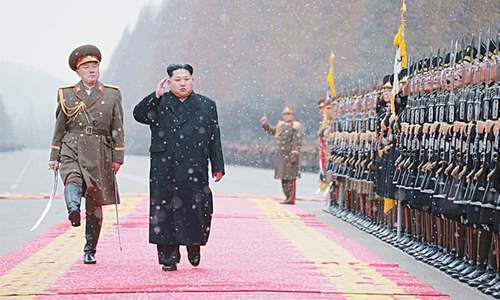
Kim Jong Un, the North's leader, may even be willing to scrap nuclear weapons if Washington takes regime change and military action off the table.
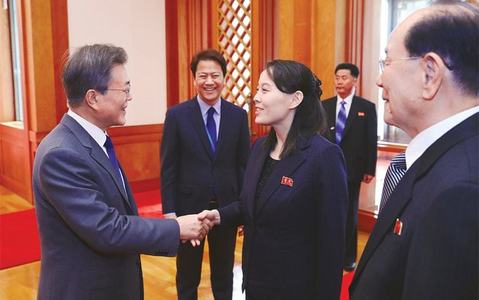
Later this week officials from South Korea, who brought the message from Kim, as well as officials from Japan and the US, will huddle in Washington to compare notes.
But until then, Trump voiced a tentative openness to North Korea's “very positive” offer, even if his administration retains deep doubts.
Director of National Intelligence Dan Coats was reticent, telling Congress “I'm quite skeptical about all of this".
“Maybe this is a breakthrough. I seriously doubt it,” he said. “Hope springs eternal.”
One senior administration official, who requested anonymity, suggested: “it's a good idea for everybody to keep some perspective, take a deep breath.”
“We have a long history, 27 years, of talking to North Korea. There is also a 27-year history of them breaking every agreement they've ever made with the United States,” the official said.
Options open
Trump's willingness — at least for now — to drop his confrontational talk of wars and “little rocket men,” is part opportunity and part necessity.
Evan Medeiros, a National Security Council director for Asia under Barack Obama, said it was likely Pyongyang, which has not yet spoken about the offer itself publicly, was trying to drive a wedge between South Korea and Washington.
“I'm deeply skeptical,” he told AFP. “Pyongyang will use talks to play for time and advantage.”
The two treaty allies have not seen eye-to-eye, with the more dovish government of President Moon Jae-in favouring carrot over Washington's stick.
The US president being seen to prematurely slam the door on talks would put a massive strain on relations with Seoul and would likely spell the end of rigorously enforced international sanctions.
It could also fuel divisions within Trump's own administration, where National Security Advisor HR McMaster has reportedly taken a harder line in favour of military action than Defense Secretary Jim Mattis.
Having lost a string of his most senior aides, including economic advisor Gary Cohn, Trump can hardly afford more resignations in protest.
Even if North Korea is serious, according to Medeiros it is not clear that Trump, who is without an ambassador to Seoul, lost his nuclear special envoy and has hollowed out the State Department, has the wherewithal to engage in real talks and simultaneously keep the coalition pressing North Korea intact.
Most analysts said Pyongyang won a decisive public relations victory over the US at the Olympics last month when Vice President Mike Pence appeared open to talks but North Koreans and South Koreans actually met.
Military options
Trump's other options are stark.
US officials privately admit that a “bloody nose” strike mooted to chasten Kim away from nukes or ballistic missile tests was never under serious consideration.
In reality, they say, any strike against North Korea would require overwhelming military force and would almost certainly put 30,000 US personnel and millions of other allied civilians in South Korea at immediate risk.
Diplomacy would seem a better option, but Trump has made clear that unlike his predecessors, he will not let the situation “fester".
On Tuesday, he reportedly held talks with former United Nations ambassador John Bolton, who is tipped to replace McMaster and recently advocated a “first strike” against North Korea.
During Trump's first visit to the Oval Office in November 2016, then-president Obama warned him he may have to make a fateful decision about North Korea, according to those familiar with the talks.
What he does now in the Oval Office could help decide whether this decades-long nuclear standoff ends on the battlefield or at the negotiating table.
But as George W. Bush found in Iraq and Afghanistan, and as Richard Nixon found in Vietnam, wars have a way of defining presidencies.