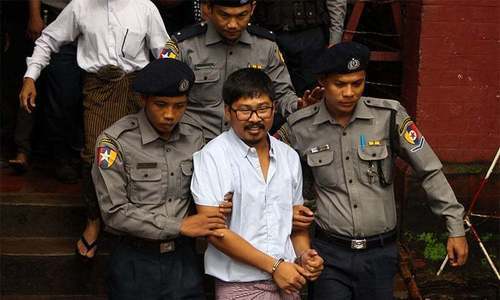
ALLEGATIONS of treachery are a useful tool to silence journalists. So it was proved again on Monday with the conviction of two Myanmar journalists, Wa Lone and Kyaw Soe Oo, under their country’s Official Secrets Act.
Both were sentenced to seven years’ imprisonment. Working for Reuters, the two were arrested last December under the draconian British colonial-era law on vague allegations of “possessing important and secret government documents related to Rakhine State and military security”. More to the point, they had incurred the authorities’ ire because they were among the rare local journalists who dared report on the massacre of the Rohingya by the Myanmar military.
Read: After massacres and rape, food being used as a weapon against Rohingya in Myanmar
The conviction follows on the heels of a UN panel’s harsh indictment of the Myanmar regime and a damning report by a fact-finding mission of the global body which recommends the country’s top military officials be investigated and prosecuted for the violence against the Rohingya. The horrific campaign of gang rape and murder — which the report describes as having been carried out with “genocidal intent” — drove 700,000 Rohingya to flee across the border into Bangladesh.
Myanmar’s military regime has on several occasions used the archaic Official Secrets Act to stifle dissent and prevent the exposure of its human rights violations. But it is not alone in those objectives.
As governments around the world exhibit an increasing tendency towards authoritarianism, the climate for journalists is growing ever more hostile. Turkey, Egypt, India and Pakistan are among the recent examples where media repression has been particularly troubling, even though it may vary in form from one country to another — at least for now.
Read: Families of jailed reporters appeal for release
In countries where the state has much to hide — a situation that goes hand in hand with scant respect for human rights — journalists are maligned as traitors and troublemakers, making them vulnerable to vigilante violence, online abuse and harassment. They have been arrested and convicted on trumped-up charges of terrorism, and subjected to enforced disappearance. Many have lost their lives — 39 so far in 2018 — either targeted or killed in the line of duty while covering conflict situations.
A number of media outlets too have been placed under tremendous financial pressure through various tactics by the state. Local and international journalist bodies must continue to demand that governments respect the right of the media to do its duty by the people. Journalists themselves, whatever their differences, must unite over this cause.
Published in Dawn, September 5th, 2018