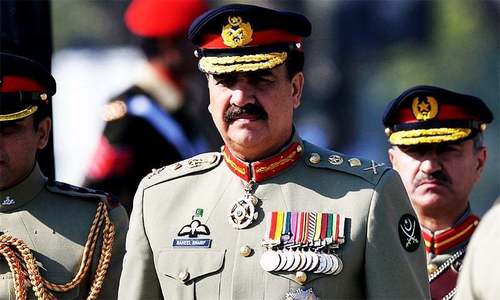
Saudi military alliance not set up to counter any country or sect, Raheel Sharif tells senators

Former army chief retired Gen Raheel Sharif on Wednesday denied the impression that the 41-nation Saudi-led military coalition that he heads was established to counter a specific country or sect, according to a statement issued by the Senate Secretariat.
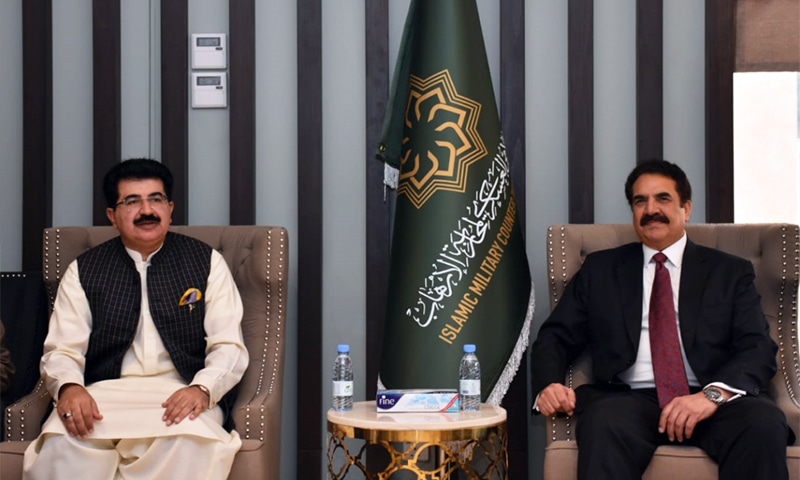
Sharif made these remarks during the visit of a Senate delegation led by Chairman Sadiq Sanjrani to the Islamic Military Counterterrorism Coalition (IMCTC) headquarters in the Saudi Arabian capital, Riyadh.
The Senate delegation was welcomed to the IMCTC headquarters by Sharif, the coalition's commander, and General Abdul Rehman, the deputy commander.

During the visit, the former army chief briefed the Senate delegation about the performance and aims and objectives of the military alliance.
"The Islamic military coalition was not formed to take action against any country, nation or sect," Sharif was quoted as saying.
Read: Thank you Raheel Sharif?
"The primary objective of this institution is to counter terrorism and eliminate it," Sharif was quoted as saying by the Senate Secretariat.
The senators during the meeting lauded the resolve and efforts of the Saudi king and government to end terrorism.
Concerns about the Saudi military alliance
The appointment of Raheel Sharif as the leader of the Saudi military alliance last year had sparked a debate over how the move will impact Pakistan's foreign policy, and whether it was fully sanctioned by the parliament.
The 41-nation armed coalition was initially proposed as a platform for security cooperation among Muslim countries and included provisions for training, equipment and troops, and the involvement of religious scholars for devising a counter-terrorism narrative.
Various quarters subsequently raised concerns about the nature of the alliance and how it may affect a pre-existing parliamentary resolution on Yemen passed unanimously by lawmakers calling for "neutrality in the conflict" in 2015.
The then defence minister Khurram Dastagir had later informed the Senate that the alliance will not take part in "unrelated military operations".