Pakistan makes slight improvement in Corruption Perceptions Index 2018


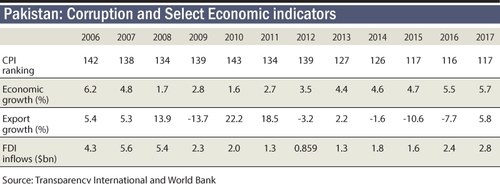
Pakistan has made a slight improvement in the ‘Corruption Perception Index (CPI) 2018’ released by the Transparency International on Tuesday, with score of 33 out of 100 — one point better than the one in 2017. The country’s ranking of 117 out of 180 countries, however, remains as it was in 2017.
On the release of the 2018 Index, Chairman of Transparency International Pakistan, Sohail Muzaffar, said that Pakistan has to act seriously to control "rampant corruption" in the country. The economic condition in the country cannot improve till this menace is tackled, he said.
"Foreign businesses check the ease of doing business before taking the decision to start working with a country. Pakistan will need to improve its ranking in the various International surveys to attract foreign investments which is necessary for it to improve its GDP growth rate," Muzaffar said.
He added that exemplary punishments should be given to all those involved in corruption. Anti-corruption laws should be strengthened and agencies governed by these laws should be able to easily prosecute the corrupt.
The 2018 CPI reveals that the continued failure of most countries to significantly control corruption is contributing to a crisis of democracy around the world.
“With many democratic institutions under threat across the globe — often by leaders with authoritarian or populist tendencies — we need to do more to strengthen checks and balances and protect citizens’ rights,” said Patricia Moreira, the managing director of Transparency International. “Corruption chips away at democracy to produce a vicious cycle, where corruption undermines democratic institutions and, in turn, weak institutions are less able to control corruption.”
More than two-thirds of countries have a score below 50, with an average score of only 43.
Since 2012, only 20 countries have significantly improved their scores, including Argentina and Côte D’Ivoire, and 16 have significantly declined, including, Australia, Chile and Malta.
Denmark and New Zealand top the index with 88 and 87 points, respectively. Somalia, South Sudan, and Syria are at the bottom of the index, with 10, 13 and 13 points, respectively.
The highest scoring region is Western Europe and the European Union, with an average score of 66, while the lowest scoring regions are sub-Saharan Africa, with the average score 32, while Eastern Europe and Central Asia have the average score of 35.