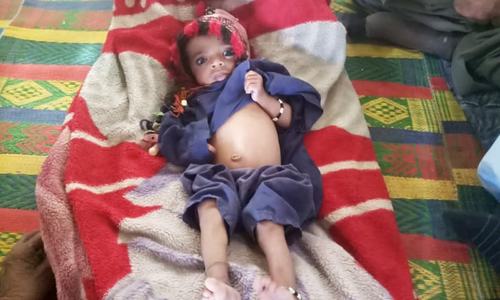
KARACHI: A frantic mother cradling her seven-month-old baby rushes towards the special paediatric ward in a desolate town, the boy’s eyes are blank and he is smaller than most newborns.
He is starving in a country that has no shortage of food, but which has one of the highest infant mortality rates in the world and where malnutrition is rife. The infant weighs just 2.5 kilograms — the average for a healthy child of that age is almost three times that.
Read Dawn's special report: Losing a generation — the impact of malnutrition
His case is not unique for the doctors at the Mithi Civil Hospital in hunger-stricken Sindh where millions survive on less than $1 a day.
Of the 150-250 patients who come in each day, roughly one-fifth are suffering from malnutrition, says Dr Dilip Kumar, head of the paediatric department.
Inside the ward, nine other malnourished infants are crying inside glass incubators. A young mother, Nazeeran, clutches the hand of her toddler. “Her weight is dropping, even though we consulted many doctors,” the 25-year-old says.
From food insecure to secure: the journey continues
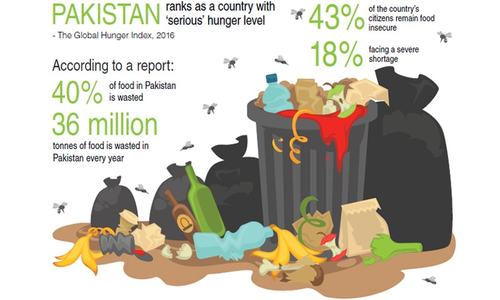
The International Food Policy Research Institute (Ifpri), a poverty and hunger watchdog, estimates around one in five of Pakistan’s more than 200 million people are malnourished.
And yet, the nation is not short of food — in fact, according to the US Department of Agriculture, it is projected to export 500,000 tonnes of wheat from May 2018 until April 2019, and 7.4m tonnes of rice in the same period.
A newspaper even reported a potato glut earlier this month.
The issues, experts say, are socio-economic — that is, just because food is available, does not mean people can access it. “There are four key pillars of food security in Pakistan: The first is availability, then accessibility, utilisation and stability,” says Dr Ambreen Fatima, senior research economist at the Applied Economic Research Centre of the Karachi University.
In Tharparkar, where Mithi Civil Hospital is located, all four are lacking, she explains, adding that in other parts of the country they are present only to varying degrees.
“Pakistan is quite well off in wheat production,” comments Dr Kaiser Bengali, a veteran economist, who has done field research on poverty and hunger, but adds that much of it is sold for export.
This means ordinary people in the country may not have access to it, and if they do they may not have the resources to pay for it.
“Affordability is the biggest challenge here in Pakistan,” he says.
Even in cities like Karachi, Bengali says he has seen alarming examples of poverty and deprivation.
“In our surveys we came across the kids who had never eaten an apple, and when we offered him an apple he was reluctant to take the bite wondering whether it was an edible thing or not,” Bengali reveals. “In another case a family had never had eggs in their whole lives,” he adds.
A survey of Planning Division in 2017 found that 40 per cent of the country’s population lives in multi-dimensional poverty.
That means they are not just short of money, but are also facing a shortage of basic needs, including health, clean water, and electricity, among other factors — all of which can impact their access to food.
“Poor physical infrastructure, particularly in the remote rural areas throughout Pakistan, is also a limitation on access to food and influences market prices,” according to a recent statement from the Food and Agriculture Organisation (FAO).
“This is also linked to inadequate water and sanitation, education and health service delivery, which together with the lack of awareness of appropriate dietary intake contributes to greater food insecurity and malnutrition.”
Published in Dawn, March 25th, 2019