

One in four Pakistani children won’t complete primary education by 2030: Unesco
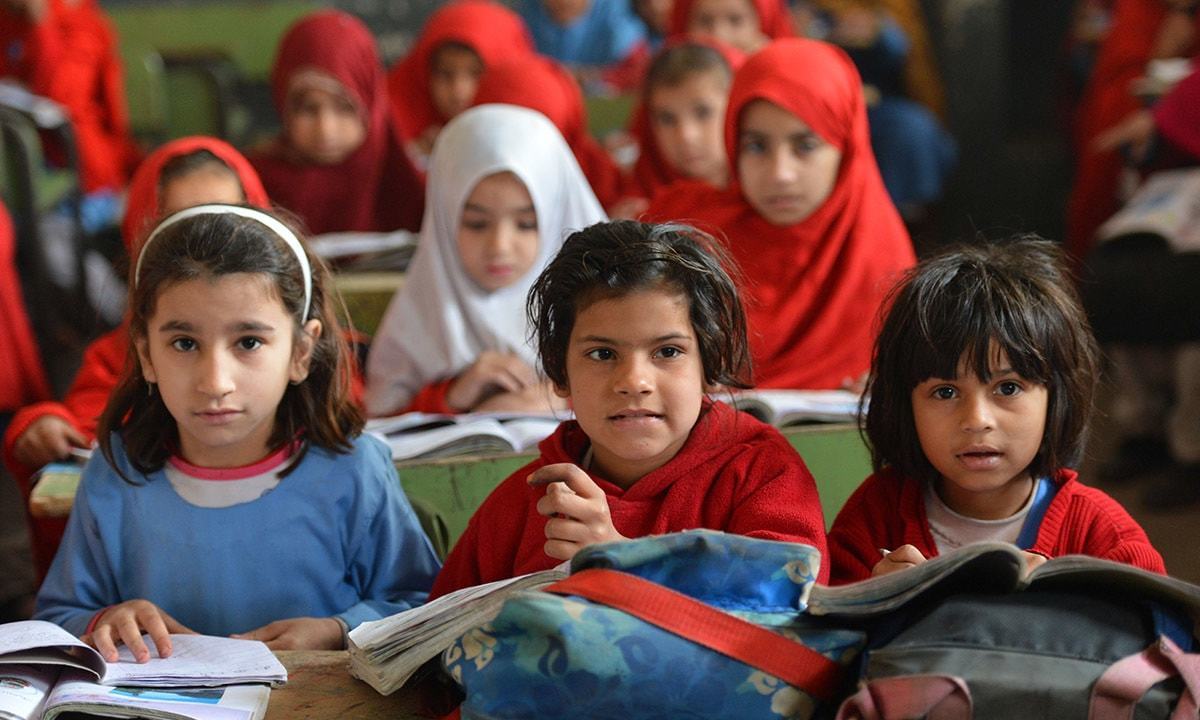

ISLAMABAD: New projections of the United Nations Educational, Scientific and Cultural Organisation (Unesco) show that one in four Pakistani children will not be completing primary school by the deadline of 2030.
The country will only be half-way to the target of 12 years of education for all, with 50 per cent of youths still not completing upper secondary education at the current rates, Unesco says.
Almost a third of the way to the 2030 deadline for the Sustainable Development Goals (SDGs), the new Unesco projections prepared for the UN High-level Political Forum opening in New York on Tuesday show that the world will fail its education commitments without a rapid acceleration of progress.
Read: 5 questions with Pakistan's Unicef education chief on the International Day of Education
In 2030, when all children should be in school, one in six aged 6-17 will still be excluded. Many children are still dropping out: by 2030, 40pc will still not be completing secondary education at current rates.
The new global education goal, SDG-4, calls on countries to ensure that children are not only going to school but also learning, yet the proportion of trained teachers in sub-Saharan Africa has been falling since 2000.
At the current trends, learning rates are expected to stagnate in middle-income countries and Latin America, and drop by almost a third in Francophone African countries by 2030. Without rapid acceleration, globally, 20pc of young people and 30pc of adults will still be unable to read by the deadline.
The 2030 Agenda for Sustainable Development emphasises leaving no-one behind yet only 4pc of the poorest 20pc complete upper secondary school in the poorest countries, compared to 36pc of the richest. The gap is even wider in lower-middle-income countries.
Finance is also insufficient for accelerating progress: the Global Education Monitoring Report calculated in 2015 that there was a $39 billion annual finance gap to reach the goal and yet aid to education has stagnated since 2010.
In addition, currently less than half of countries are providing the data needed to monitor progress towards the goal. “Countries need to face up to their commitments,” said the Director of the Unesco Institute for Statistics, Silvia Montoya. “What’s the point in setting targets if we can’t track them? Better finance and coordination are needed to fix this data gap before we get any closer to the deadline.”
Read: Tackling the menace of a failed education system
Manos Antoninis, Director of the Global Education Monitoring Report, stated that “Countries have interpreted the meaning of the targets in the global education goal very differently. This seems correct given that countries set off from such different starting points. But they must not deviate too much from the promises they made back in 2015. If countries match their plans with their commitments now, they can get back on track by 2030”.
The report shows that many countries have prioritised equity and inclusion since 2015 to meet the goal, with school vouchers issued to indigenous students, tuition fees abolished for the poorest and conditional cash transfers given to refugee children.
Learning has been prioritised too, with a third of countries introducing learning assessments to look at trends over time, and one in four countries using learning results to reform their curricula.
The weakest synergies between countries’ plans and their education commitments are seen in the lack of cross-sectoral collaboration found only in links between education and the labour market.
Published in Dawn, July 10th, 2019































