

Iceland commemorates first glacier lost to climate change
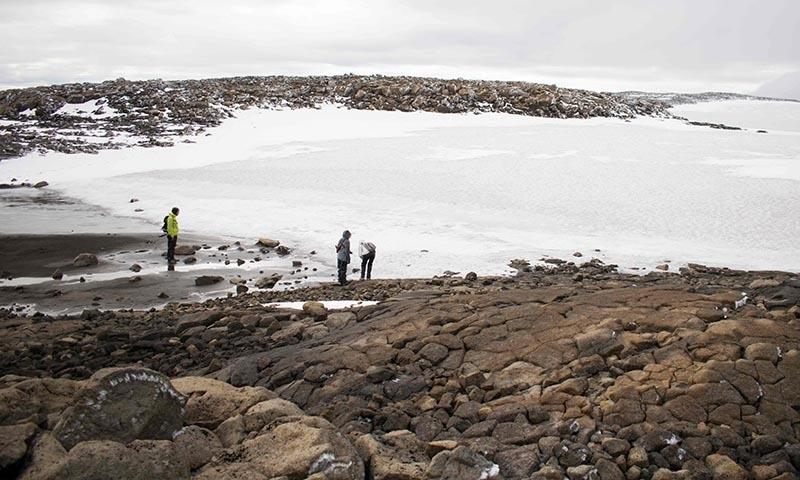

REYKJAVIK: Iceland on Sunday honoured the passing of Okjokull, its first glacier lost to climate change, as scientists warned that some 400 others on the subarctic island faced the same fate.
A bronze plaque was unveiled in a ceremony to mark Okjokull — which translates to “Ok glacier” — in the west of Iceland, in the presence of local researchers and their peers at Rice University in the United States, who initiated the project.
“This will be the first monument to a glacier lost to climate change anywhere in the world,” Cymene Howe, associate professor of anthropology at Rice University, said in July.
The plaque bears the inscription “A letter to the future”, and is intended to raise awareness about the decline of glaciers and the effects of climate change.
“In the next 200 years all our glaciers are expected to follow the same path. This monument is to acknowledge that we know what is happening and what needs to be done. Only you know if we did it,” the plaque reads.
It is also labelled “415 ppm CO2,” referring to the record level of carbon dioxide measured in the atmosphere last May.
“Memorials everywhere stand for either human accomplishments, like the deeds of historic figures, or the losses and deaths we recognise as important,” researcher Howe said.
“By memorialising a fallen glacier, we want to emphasise what is being lost — or dying — the world over, and also draw attention to the fact that this is something that humans have ‘accomplished’, although it is not something we should be proud of.”
Howe noted that the conversation about climate change could be abstract, with many dire statistics and sophisticated scientific models that could feel incomprehensible. “Perhaps a monument to a lost glacier is a better way to fully grasp what we now face,” she said, highlighting “the power of symbols and ceremony to provoke feelings”.
Iceland loses about 11 billion tonnes of ice per year, and scientists fear all of the island country’s 400-plus glaciers will be gone by 2200, according to Howe and her Rice University colleague Dominic Boyer.
Glaciologists stripped Okjokull of its glacier status in 2014, a first for Iceland.
In 1890, the glacier ice covered 16 square kilometres but by 2012, it measured just 0.7 square kilometres, according to a report from the University of Iceland from 2017.
In 2014, “we made the decision that this was no longer a living glacier, it was only dead ice, it was not moving,” Oddur Sigurdsson, a glaciologist with the Icelandic Meteorological Office, said.
To have the status of a glacier, the mass of ice and snow must be thick enough to move by its own weight. For that to happen the mass must be approximately 40 to 50 metres thick, he said.
Published in Dawn, August 19th, 2019






























