Emirati becomes first Arab to reach ISS



An Emirati has made history as the first Arab to reach the International Space Station, after blasting off from Kazakhstan.
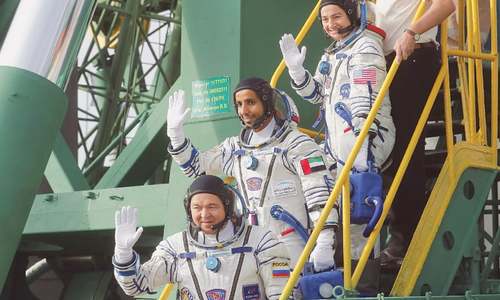
The Russian spacecraft carrying Hazzaa al-Mansoori of the United Arab Emirates, who was accompanied by Russia's Oleg Skripochka and NASA astronaut Jessica Meir, docked Wednesday after a six-hour trip.
The three "entered the orbiting lab and joined six of their station crewmates for a joyful crew greeting ceremony today," NASA tweeted.
A video shows the new arrivals entering head first through a hatch to join their grinning colleagues, who welcomed them with floating hugs.
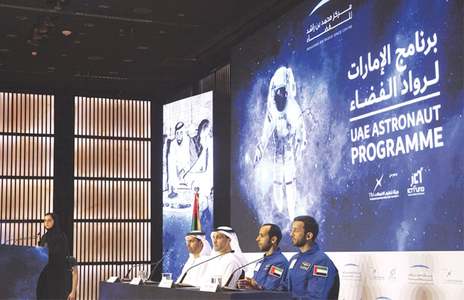
Mansoori, 35, received support from around the world ahead of what he described as his "dream" mission.
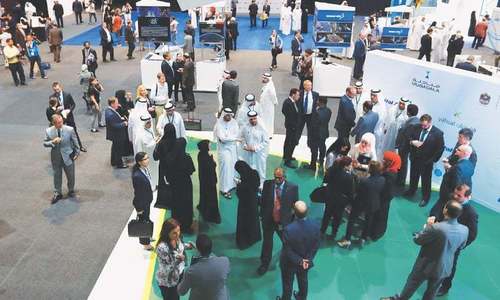
In Dubai, a crowd gathered at the Mohammed Bin Rashid Space Centre to watch the launch, erupting in cheers and dubbing Mansoori a national hero. Some carried UAE flags.
Dubai's iconic Burj Khalifa, the world's tallest skyscraper, lit up the moment of blast-off.
'Glory and awe'
Mansoori will spend eight days on the ISS and will be the first Emirati and the first Arab on the orbiting laboratory, but not the first Muslim.
Writing on Twitter before the launch at Baikonur space centre, the former pilot in the UAE armed forces said he was "filled with this indescribable feeling of glory and awe".
"Today I carry the dreams and ambition of my country to a whole new dimension. May Allah grant me success in this mission," he said.
The day before the launch, he said he would record his prayer routine on the ISS and broadcast it to people on Earth.
"As a fighter pilot I already prayed in my aircraft," he said, explaining that he had experience of prayers at high speed.
Mansoori plans to conduct experiments and said he would take Emirati food with him to share with the crew, who for a brief of time will number nine at the ISS.
At a pre-flight conference, Meir, 42, said the crew communicated by using "Runglish" — a mixture of Russian and English.
"We still need to work on our Arabic," she joked.
Russian Orthodox priests blessed the spacecraft ahead of the launch, in a traditional prayer service often held before Russian rocket launches.
The spacecraft was the last to blast off from the launch pad where Soviet cosmonaut Yuri Gagarin went off into space onboard the Vostok 1, becoming the first man in space in 1961.
Mansoori is set to return to Earth with NASA's Nick Hague and Russian cosmonaut Alexey Ovchinin on October 3. Skripochka and Meir are set to remain on the ISS until the spring of 2020.
The first Arab in outer space was Saudi Arabia's Sultan bin Salman Al-Saud, who flew on a US shuttle mission in 1985.
Two years later, Syrian air force pilot Muhammed Faris spent a week aboard the Soviet Union's Mir space station. As part of its space plans, the UAE has also announced its aim to become the first Arab country to send an unmanned probe to orbit Mars by 2021, naming it "Hope".
The International Space Station — a rare example of cooperation between Russia and the West — has been orbiting Earth at about 28,000 kilometres (17,000 miles) per hour since 1998.
Russia is resolved to keep its position as a leader of the space industry, particularly for manned space flights.