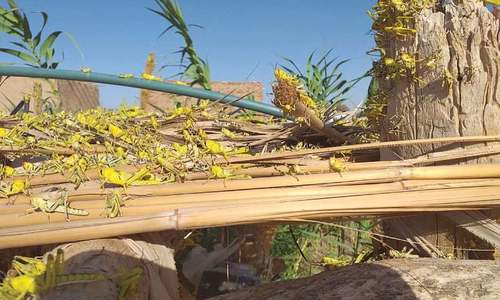
As swarms of desert locust descend upon Karachi, ministry says species pose no risk to food supply


The Department of Plant Protection of the Ministry of National Food Security and Research has said that the desert locust activity observed in Malir and adjoining areas of Karachi is part of the creature's migration from summer-monsoon breeding zone towards coastal areas of Balochistan and does not pose any risk to food supply.
The technical director of the plant plantation department, Muhammad Tariq Khan, said on Sunday that the desert locust fly during day time and settle during the night, adding that the migration activity usually does not cause damage since the locusts are not in search of food.
Swarms of desert locust have been seen in various areas of Karachi, including Sharea Faisal and Bahadurabad. The last time the metropolis suffered from a locust attack was in 1961.
Khan explained that the desert locust's preferred habitat is desert area. Sandy soil with moisture and vegetation are required for their oviposition and breeding.
He added that the department was monitoring the situation closely and that the desert locust control teams were prepared to overcome any risks the species might pose as per technical guidelines.
In Pakistan, desert locust has two breeding seasons and regions: winter-spring breeding zone located in desert areas of Balochistan which prevails during February to June and summer-monsoon breeding zone located in Tharparkar, Nara and Cholistan deserts, which takes place from June to November.
This year, there is an upsurge in desert locust population in countries that are the potential habitat of the species from the West African region to the subcontinent.
Pakistan government since March 2019, has surveyed an area of 550,000 hectares and secured 110,000 hectares areas by ground and aerial spray in Balochistan, Sindh and Punjab. Due to preventive measures, the desert locust's movement was limited to desert areas and it was not able to attack cultivated areas.
Locusts are short horned grass hoppers. Desert locusts of Africa and Asia are normally solitary, but spring rains trigger a behavioural transformation that can results in a swarms of locust. A single swarm ranges from 100,000 to 1 billion locusts.