Islamabad, Kabul look forward to new era in ties
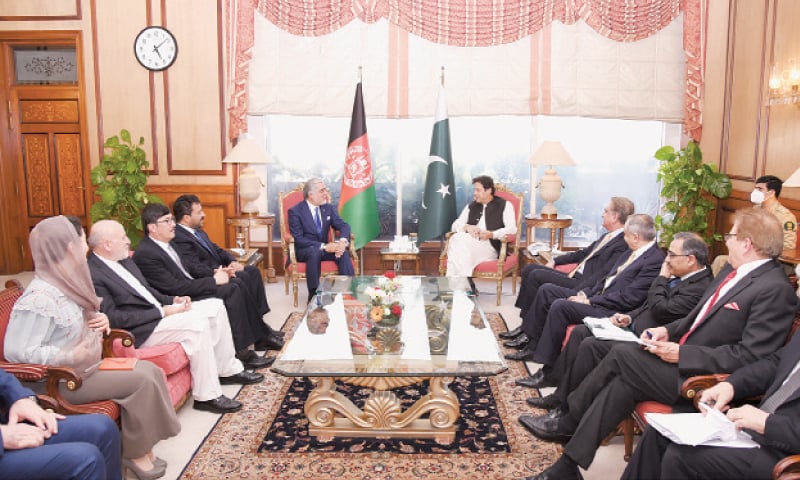

ISLAMABAD: Top Afghan peace official Abdullah Abdullah on Tuesday emphasised the centrality of Pakistan’s role for peace in his country as both sides agreed on turning over a leaf in their ties marred by mutual mistrust and acrimony.
Remarks by Chairman of Afghanistan’s High Council for National Reconciliation Abdullah Abdullah and Foreign Minister Shah Mahmood Qureshi at the Institute of Strategic Studies Islamabad (ISSI) and Prime Minister Imran Khan’s conversation with the visiting Afghan official unmistakably pointed to an impending paradigm shift in the way the two countries have so far conducted their bilateral ties.
Dr Abdullah arrived in Islamabad on Monday on a three-day trip accompanied by a high-level delegation for talks on the peace process and bilateral relations.
“Pakistan played a critical role in facilitating the talks, and has even a more important role to play here on not only supporting the process through a successful end, but also in standing with the people and government of Afghanistan in building a peaceful and prosperous neighbourhood,” he said at ISSI.
Abdullah sees Pakistan’s key role in Afghan peace
Pakistan is being credited for the start of intra-Afghan dialogue, currently under way in Doha. Islamabad had also facilitated US-Taliban agreement that paved the way for the talks between the Afghan groups.
But, frayed ties have impeded cooperation between the two neighbours.
Dr Abdullah said: “After many troubling years, we now need to go beyond the usual stale rhetoric and shadowy conspiracy theories that have held us back.”
“We then need to draw the necessary lessons about our gains and losses, threats and opportunities, especially where we could have been today if we had aimed for stronger win-win solutions, reduced tensions, promoted moderation, increased regional connectivity, trade, transit, economic integration, Business to Business (B2B) and importantly People to People (P2P) interactions,” he further said.
Foreign Minister Qureshi too called for “recognition of the mistakes of past” and “adding a new chapter to bilateral ties”.
He reassured Dr Abdullah and his accompanying delegation that Pakistan had “no favourites in Afghanistan”, did not want to “meddle in Afghanistan’s internal affairs” and respected its sovereignty, independence and territorial integrity.
The foreign minister said Pakistan would support whatever consensus emerges during Doha peace talks and accept “will of the people of Afghanistan”. Pakistan has over the past few weeks repeatedly called on all Afghan sides to lower violence, but at ISSI, Mr Qureshi put greater emphasis on reduction in violence, saying it was a “pre-requisite for peace”.
A sharp spike in violence in Afghanistan has been witnessed during the three weeks of talks in Doha. Kabul wants Taliban to agree to ceasefire, but the insurgents are linking it to progress towards a political settlement.
Mr Qureshi underscored that a relationship between the two neighbours based on “cooperation and understanding” was the only way forward.
He asserted that Pakistan would like to be “friends not masters” of Afghanistan.
Prime minister
Later in the evening, Dr Abdullah called on Prime Minister Imran Khan.
Mr Khan hoped that Dr Abdullah’s visit will help open a new chapter in the bilateral relationship between Pakistan and Afghanistan.
He reiterated that Pakistan would support whatever Afghans agree upon about the future of Afghanistan. He also reaffirmed full support for the post-conflict Afghanistan on its path to reconstruction and economic development.
Published in Dawn, September 30th, 2020