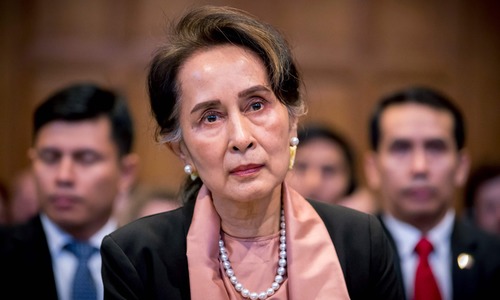
ONCE more, the generals have struck in Myanmar, sending the elected government of Aung San Suu Kyi’s National League for Democracy packing. Reports emerging from the country have said that Ms Suu Kyi — the de facto leader of Myanmar — as well as the president are in detention, while the armed forces have declared a year-long state of emergency.
Myanmar, formerly known as Burma, had emerged from decades of military rule in 2011 and was being run under a hybrid system where the generals dominated the state’s affairs, and allowed limited democratic activity. For example, around a quarter of the seats in parliament were reserved for uniformed lawmakers nominated by the military’s top brass, giving them effective ‘check’ over civilian MPs. However, despite controlling the levers of state, it seems the generals were uneasy with growing civilian power, as the NLD performed well in November’s elections. The country’s top general claimed there were “huge irregularities” in the polls, though the Myanmar election commission said it had no evidence of fraud.
Unfortunately, the situation Myanmar faces is a familiar one for many developing states, including Pakistan, where democratic experiments are too often interrupted by unconstitutional interventions, retarding the political growth of states. Ms Suu Kyi was not an ideal leader. For example, while she had struggled for years to establish democracy and fight for human rights in her homeland, upon gaining power she ignored the plight of the Muslim Rohingya, who were systemically butchered in Rakhine state. However, there is no justification for the military coup and power must be handed back to the civilians.
Myanmar suffers from ethnic and religious strife, and the only way to end these various conflicts is through the democratic process, ensuring that people of all religious persuasions and ethnic backgrounds are given equal rights. Things may deteriorate further under the generals’ watch, as the military is known to support a xenophobic extremist Buddhist nationalist narrative. There has been condemnation from all right-thinking governments around the world, and the matter is due to be taken up at the UN. The international community must make it clear that the coup is unacceptable and will have consequences unless power is handed back to the elected government. Myanmar’s democracy was anything but perfect. But allowing an imperfect democracy to grow and evolve is preferable to allowing unelected adventurers to toy with a nation’s future.
Published in Dawn, February 2nd, 2021