‘Non-implementation of labour laws could lead to anarchy’


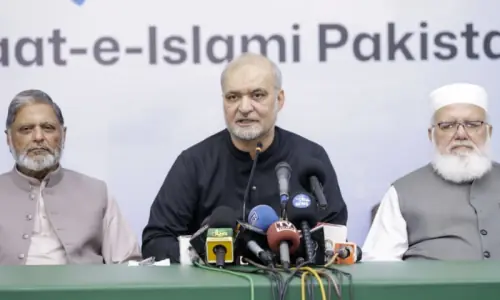
KARACHI: “Laws are made to be implemented, not to be stored inside cupboards,” said Habibuddin Junaidi, president, Peoples Labour Bureau, Sindh. He was speaking at a joint press conference on labour issues called by labour activists and trade union leaders in connection with May Day at the Karachi Press Club on Friday.
“The PPP government has passed some very fine labour-friendly laws such as the Sindh Occupational Safety and Health Act, the Sindh Home-Based Workers Act, the Sindh Covid-19 Emergency Relief Ordinance, etc, but non-implementation of these laws is [a matter of concern], especially in the private sector,” he said.
“The non-implementation of the laws can also give way to anarchy, which will be bad for workers and this country. Therefore, I urge the labour department to look into implementing the laws and the provincial government should also push for reforms and more benefits for workers,” he said.
Zehra Khan of Home-Based Women Workers Federation also said that “the coronavirus has not just killed people, it has also killed people’s livelihoods, and informal and domestic workers are the worst hit.
“As for the implementation of labour-friendly laws, the registration process for home-based workers, which [was] to commence last November, also could not happen. Meanwhile, salaries are not increasing as inflation is on a constant rise,” she regretted.
Labour leaders demand rights, benefits for workers on May Day
Nasir Mansoor of National Trade Union Federation said that he saw fascist tendencies in all that was happening here. “The welfare of workers is not on the government’s agenda, it seems. Every five years or so, capitalism shows us its cruel face. We need a new world order to protect the rights of workers. Labour generates capital, but here it has become the opposite of that,” he said.
Karamat Ali of Pakistan Institute of Labour Education and Research also reminded about the history of May Day. “The main demand of the Chicago workers in 1889 was that the working hours should be a maximum of eight hours. After the movement, their demand was accepted and after World War II, many conventions were passed by the International Labour Organisation [ILO] to facilitate workers. The first convention of the ILO is pertaining to about eight hours of work.
“Even in Pakistan, it is illegal to make workers work for more than eight hours. But in reality, they are forced to work for 10 to 12 hours as they are also deprived of overtime. This specially is more common in the private sector where 12 to 14 hours of work is considered normal. In fact, this is how the owners of private companies save time and engage fewer workers which also endangers workers’ health and safety,” he pointed out.
“For the past decades, the domestic economic policies of various governments in Pakistan have been focused on meeting the IMF’s requirements, which has led to a steady increase in non-development expenditures. While education, health and public welfare facilities have been reduced and disrupted due to cuts in the development budget, the worst effect of all these policies has been on the working and middle classes. Unemployment has risen sharply in the country and the contract system for jobs has flourished, which has led to a huge increase in insecurity in society.
Earlier, Farhat Parveen of NOW Communities said that the government agencies mandated to provide fundamental rights and welfare to workers were not able to carry out their work effectively, which was why a large majority of workers were unable to benefit from these institutions. She demanded that all the ILO conventions ratified by Pakistan be implemented.
“It should be ensured that government agencies comply with these laws. It is also the responsibility of the government to provide a conducive environment for union formation and to encourage organisation in all areas,” she said.
The speakers also said that there had been no increase in the minimum wage rate in Pakistan during the current financial year. Only the Punjab government had issued a notification to increase the minimum wage this week, while the Sindh government had not yet increased the wages. They said that many meetings had been held in this regard, but nothing positive emerged. Last year, there was no increase made by any provincial government on the occasion of Labour Day and they used the lockdown as an excuse for it.
They demanded that on the occasion of this Labour Day, all provincial governments should announce a significant increase in the minimum wage because the inflation rate was quite high. Trade unions, in the past, too, have been demanding to fix the minimum wage for workers equal to one tola or 11.7 grams of gold, but in these circumstances the wages should be set at a minimum of Rs35,000 per month or equal to the living wages, and it should be the same in each province.
They also said that co-operation in this regard is urgently needed in the South Asia region where a majority of the population is suffering due to the coronavirus pandemic.
Published in Dawn, May 1st, 2021