‘New type of early human’ found in Israel, say researchers


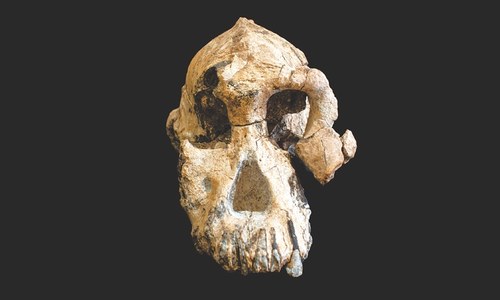
JERUSALEM: Bones belonging to a “new type of early human” previously unknown to science have been found in Israel, researchers said on Thursday, claiming to have shed new light on human evolution.
Excavations in the quarry of a cement plant near the central city of Ramla uncovered prehistoric remains that could not be matched to any known species from the Homo genus.
Researchers from Tel Aviv University and the Hebrew University of Jerusalem dubbed the “extraordinary discovery” the “Nesher Ramla Homo type” after the site, in a study published in the journal Science.
The fossils date to between 140,000 and 120,000 years ago, and the team believes the Nesher Ramla type would have overlapped with Homo sapiens, the lineage of modern humans.
“We had never imagined that alongside Homo sapiens, archaic Homo roamed the area so late in human history,” lead archaeologist Yossi Zaidner said.
“The morphology of the Nesher Ramla humans shares features with both Neanderthals... and archaic Homo,” the researchers said in a statement.
“At the same time, this type of Homo is very unlike modern humans — displaying a completely different skull structure, no chin and very large teeth.”
Along with the human remains, the dig uncovered large quantities of animal bones as well as stone tools.
“The archaeological finds associated with human fossils show that ‘Nesher Ramla Homo’ possessed advanced stone-tool production technologies and most likely interacted with the local Homo sapiens,” Zaidner said.
The researchers suggested that some fossils previously discovered in Israel dating back as far as 400,000 years could belong to the same prehistoric human type.
Dentist and anthropologist Rachel Sarig of Tel Aviv University said that previously researchers had tried to ascribe the older bones to known human groups like Homo sapiens or Neanderthals.
“But now we say: No. This is a group in itself, with distinct features and characteristics,” she said.
The Israeli researchers make the still controversial claim that the discovery of a new archaic Homo group in the Middle East challenges accepted ideas that Neanderthals originated in Europe.
“Before these new findings, most researchers believed the Neanderthals to be a ‘European story’, in which small groups of Neanderthals were forced to migrate southwards to escape the spreading glaciers,” Tel Aviv University’s Israel Hershkovitz said. “Our findings imply that the famous Neanderthals of Western Europe are only the remnants of a much larger population that lived here in the Levant — and not the other way around.”
Sarig said small groups of the Nesher Ramla type likely migrated into Europe, later evolving into Neanderthals, and Asia, developing into populations with similar features.
Published in Dawn, June 26th, 2021