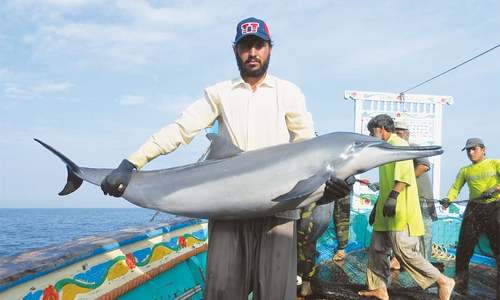
Outcry as Faroe Islands slaughter 1,400 dolphins in a day


The government of the Faroe Islands, an autonomous Danish territory, faced an outcry on Tuesday over the culling of more than 1,400 white-sided dolphins in a day — as part of a traditional practice — in what was said to be the single biggest hunt in the northern archipelago.
The Associated Press reported that a local activist published gruesome video footage of Sunday’s slaughter of 1,428 white-sided dolphins on the central Faeroese island of Eysturoy in the North Atlantic archipelago.
Photos showing the bloodied corpses of more than 1,000 Atlantic white-sided dolphins on the beach sparked outrage on social media.
“There is no doubt that the Faroese whale hunts are a dramatic sight to people unfamiliar to the hunts and slaughter of mammals,” a government spokesperson told AFP. “The hunts are, nevertheless, well organised and fully regulated.”
Traditionally, the North Atlantic islands — which have a population of around 50,000 people — hunt pilot whales and not dolphins, the spokesperson said.
“There are usually a few of them in the 'grind', but we normally don't kill such a large number,” said a local television journalist, Hallur av Rana.
The “grindadrap” is a practice whereby the hunters first surround the whales with a wide semi-circle of fishing boats and then drive them into a bay to be beached and slaughtered.
According to av Rana, some 53 per cent of the islands' population are opposed to hunting dolphins. There are, however, no plans to abolish the “grind”, which authorities insist is a sustainable way of hunting.
Meanwhile, Fisheries Minister Jacob Vestergaard said everything this year was done by the book in the dolphin hunt.
'Barbaric practice'
Sea Shepherd, a charity that campaigns against the hunting of whales and dolphins, described it as a “barbaric practice”.
The international animal rights group said on Wednesday it hopes that pressure will build from within the Faeroe Islands to end its traditional drive of sea mammals into shallow water, where they are slaughtered for their meat and blubber.
“It was a complete disaster, completely unprecedented in fact, it could even be the largest single hunt of cetaceans in documented history anywhere in the world,” said Robert Read, campaign director for the Sea Shepherd Conservation Society.
Environmental activists have long claimed the practice is cruel. But this year, even people on the Faeroes who defend the four-century-old practice have spoken out amid fears that this year’s slaughter will draw unwanted attention.
“We must admit that things did not go as we would like to,” said Hans Jacob Hermansen, the former chairperson of the Faeroese association behind the drives. “We are going to evaluate if anything went wrong, what went wrong and why, and what can we do to avoid that in the future.”
Sea Shepherd says it is hoping for “much tighter restrictions” around such hunts and, if not, “at least a ban on the killing of the Atlantic white-sided dolphins.”
Faeroese hunters are used to criticism from animal rights groups and push back at what they see as an interference in a cultural practice.
Each year, islanders drive herds of the mammals — chiefly pilot whales — into shallow waters, where they are stabbed to death. A blow-hole hook is used to secure the beached whales and their spine and main artery leading to the brain are severed with knives, turning water in the bay red with blood. The drives are regulated by law and the meat and blubber are shared on a community basis.
According to local estimates, there are around 100,000 pilot whales in the waters around the Faroe Islands and around 600 were killed last year.