China records lowest birth rate since 1949


BEIJING: China’s birth rate plummeted to a record low last year, official data showed on Monday, as analysts warn that faster-than-expected ageing could deepen economic growth concerns.
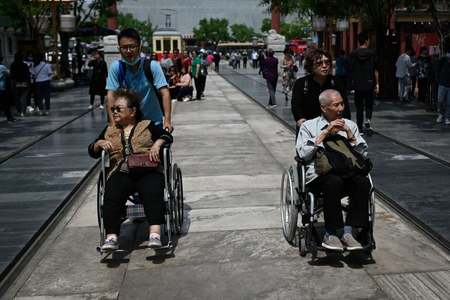
Beijing has been grappling with a looming demographic crisis as it faces a rapidly ageing workforce, slowing economy and the country’s weakest population growth in decades.
The birth rate of the world’s second-biggest economy slipped to 7.52 births per 1,000 people, according to National Bureau of Statistics data, down from 8.52 in 2020.
The figures are the lowest since records began in 1949, when Communist China was founded, according to NBS data.
It also marks the lowest figure logged in China’s annual Statistical Yearbook data — a yearly assessment of the country’s economy — dating back to 1978.
Although officials relaxed the nation’s one-child policy in 2016 — allowing couples to have two children and easing some of the world’s strictest family planning regulations — the changes have failed to bring about a baby boom.
Last year, Chinese authorities extended the policy further to allow couples to have three children.
But in 2021, the country logged 10.62 million births, according to official data, bringing its population to 1.41 billion.
The natural population growth rate plunged to 0.34 per 1,000 people, from an earlier 1.45 figure.
“The demographic challenge is well known but the speed of population aging is clearly faster than expected,” said Zhiwei Zhang, chief economist at Pinpoint Asset Management.
“It also indicates China’s potential growth is likely slowing faster than expected,” he said.
Last year, results of a once-in-a-decade census showed that China’s population had grown at its slowest rate since the 1960s.
Higher costs of living and a cultural shift, with people now used to smaller families, have been cited as reasons behind the lower number of babies.
The one-child policy was introduced by top leader Deng Xiaoping in 1980 to curb population growth and promote economic development, with exceptions for rural families whose first-born was a female and for ethnic minorities.
Published in Dawn, January 18th, 2022