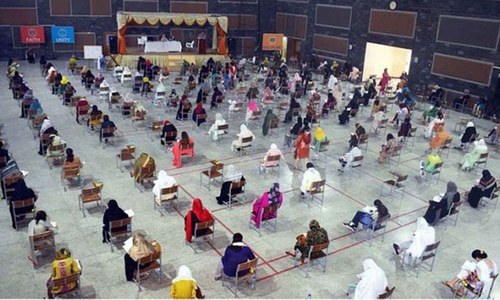
KARACHI: The fate of over 800 students hangs in the balance after the Sindh High Court declared void the provincial government’s decision to reduce passing marks of the Medical and Dental Colleges Admission Test (MDCAT) conducted last year from 65 per cent to 50pc.
Sources told Dawn on Friday that the government was in a fix over the matter and might opt for filing an appeal against the decision before the apex court, or seeking a “relief” from the Pakistan Medical Commission (PMC) for a year on the minimum pass percentage set by the commission for MDCAT.
“If both options don’t work, affected students may go to court as now they can’t even switch to allied fields like pharmacy and physiotherapy, which are the first choice of students who fail to get admission to MBBS and BDS [programmes],” said a senior professor associated with the admission process.
He added that admission to pharmacy and physiotherapy had been closed two months back.
Sindh govt may seek one-year relief from PMC on MDCAT’s passing marks
The sources said 200 students got admission to MBBS whereas 650 to BDS in colleges in the province on the basis of less than 65pc marks that they obtained in the MDCAT.
Most of the affected students were in private institutions.
The tests had attracted protests and criticism from students and professional bodies across the country.
The tussle between the provincial and federal governments over MDCAT was described as sad and disappointing.
‘Students interests ignored’
Reacting to the SHC decision, senior doctors said the matter should have been sorted out amicably, protecting the interests of students.
“I am daily getting calls from concerned students and their parents, asking me what would happen now, and I don’t have any answer,” said Dr Syed Razi Muhammad, president of Pakistan Association of Private Medical and Dental Institutions-Sindh chapter.
“This episode reflected official indifference towards the country’s youth. This would never happen in a civilised country. Nobody thought about the future of these children,” he said.
Dr Qaiser Sajjad of the Pakistan Medical Association (PMA) said the issues raised by the association had remained unattended even after the court’s decision.
“Our concerns pertain to the lack of consultation on the establishment of PMC and the flawed mechanism adopted for carrying out medical and dental tests. Students’ had genuine reservations, which should have been timely addressed. One of them was the different syllabus taught in different provinces on the basis of which the test was prepared,” he said.
In India, Dr Sajjad pointed out, the government took four years of paperwork and consultation to shift from the Indian Dental and Medical Council to Indian Medical Commission. “There was no confrontation and no students’ loss because matters were sorted out with consultation. Unfortunately, this was not the case in Pakistan. The Sindh government had a genuine demand that they should have been consulted in the formation of the PMC.”
Sharing concerns of affected students, he said the PMC should have given a one-year relief and implemented the rule of 65pc minimum marks in MDCAT next year.
“Also, students who had appeared in the MDCAT should have been provided with a carbon copy of their answer sheets for the purpose of transparency,” he said.
Weak legal ground
On SHC’s decision, sources said the judges’ remarks during the proceedings highlighted the weak legal ground adopted for the case by the provincial government The court in its detailed verdict ruled: “Quite strangely the Sindh government has only objected to fixing of benchmark (65%) to attain in the test to become eligible to admission and has otherwise expressly no issue to the whole mechanism employed for conducting the test, selecting procedure and syllabus for framing the questions, etc.
“This we find rather paradoxical and unsustainable, as on the one hand it has questioned legitimacy of the law as a whole on the ground of having residuary jurisdiction over the matter, and on the other hand has invoked the same law for selecting students for admission by reducing pass marks to 50%,” it added.
The PMC had challenged the Dec 2 decision of the Sindh cabinet of lowering the passing marks for MDCAT-2021 from 65pc to 50pc.
It also challenged four notifications, the decision of the admission committee and advertisements issued by the Jinnah Sindh Medical University (JSMU) and Shaheed Motarma Benazir Bhutto Medical University, Larkana, as well as other actions and steps taken in pursuant of the cabinet decision of lowering passing marks of MDCAT.
Prior to the decision, the tussle between the Sindh government and PMC over MDCAT had continued for months and both warned educational institutions to follow their policies or face consequences.
Published in Dawn, March 26th, 2022