“Patriotism is the virtue of the vicious.” — Oscar Wilde
THE falsified use of the ‘patriotism’ label is not uncommon in Pakistan’s power politics. Yet Imran Khan has taken the charade to a new level altogether. His narrative that he is the sole defender of the national interest comes across as deceitful, while branding his political opponents as traitors has set a dangerous precedent.
Most troubling are his recent speeches that have called upon his supporters to protest outside the houses of party dissidents, as he alleges they are part of a ‘foreign conspiracy’. There have been some reports of PTI supporters harassing opposition members. These can be seen as fascist tendencies — when ‘nationalism’ is used as a tool to suppress dissenting voices.
Read: Why Imran's self-serving pseudo sense of national pride is an injustice to Pakistan
What happened in the National Assembly last Sunday was scripted. It took a few minutes for the deputy Speaker to throw out the no-confidence motion on the pretext that the move was a ‘foreign-inspired’ one. The prime minister justified this blatant violation of the Constitution by indicating that an ‘American-backed conspiracy’ had been thwarted.
He has resorted to unfounded allegations to escape the humiliation of being voted out by elected representatives. This unprecedented episode has also put at stake the country’s credibility as a normal state. Can we expect any nation to take us seriously when our democratic political process is disrupted on fabricated charges?
What could be more preposterous than a comparison between a philistine and a visionary?
Intriguingly, the allegation has been built around a cable from the outgoing Pakistan ambassador to Washington, based on his conversations with senior-level US State Department officials. It is simply a diplomat’s analysis of the existing views in Washington regarding the Khan government. The content of the ambassador’s letter has reportedly been shared with some cabinet ministers and the top military leadership. But security sources are reported to have said that there was no mention of any foreign plot to overthrow the prime minister.
Editorial: Is national security really at risk? It is time we are provided a fair and comprehensive assessment
Moreover, there is no evidence that the opposition’s no-confidence move is part of a foreign conspiracy. The PTI has also been misconstruing a statement issued after a meeting of the National Security Committee, dragging the military leadership into the controversy. The PTI’s move to whip up nationalist sentiments has dangerously polarised the country.
With the cable’s contents not made public, the campaign has caused confusion. Undoubtedly, our relations with Washington have been cold, but some undiplomatic comments about the Imran Khan government cannot be interpreted as a plot for regime change.
It seems to be a desperate move on the part of the PTI leadership to try and salvage its diminishing political support. The nationalist rhetoric may motivate its hard-core supporters, but it is doubtful if it can cover up the party’s reckless actions. Overuse of the nationalist card has its own perils, and it harms national cohesion.
It is not only the opposition but also journalists and members of civil society who are being targeted in this ongoing vicious propaganda campaign orchestrated by the party’s top leadership. Even social interaction with foreign diplomats is now labelled as anti-state. This kind of a witch-hunt is unprecedented.
Imran Khan claims that he is being punished for pursuing an independent foreign policy and for not surrendering to the pressure of Western countries. He has lately started comparing himself with Zulfikar Ali Bhutto, who was the architect of an independent and dynamic foreign policy. What could be more preposterous than a comparison between a philistine and a visionary?
In fact, Imran Khan’s limited understanding of foreign policy, which he has tried to substitute with populist rhetoric, has damaged Pakistan’s relations with even friendly countries. He has attempted to blend foreign policy with his regressive worldview. His naïve comments on complex international matters have often put Pakistan in an embarrassing position. His decisions on some of the most sensitive foreign policy issues have been driven by whims rather than reason. His thoughtless actions have led to a loss of face for the country many times.
The prime minister’s Trumpian approach to sensitive policy issues is well known and was reflected in his last-minute decision to pull out of the Kuala Lumpur Summit of Islamic countries in December 2019. The decision to attend the summit, without considering the pros and cons in light of foreign policy, had not been a sound move. But to back out of it, because of pressure from another country — Saudi Arabia — was worse.
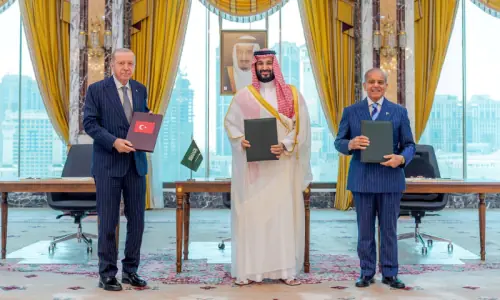
Riyadh had reportedly threatened to send thousands of Pakistani expats home if the prime minister attended the summit. Nothing is more mortifying for a sovereign nation than to have to accept another country’s diktat and back out of an international commitment. It marked a new low for our diplomacy. In fact, it is difficult to remember when else, in the recent past, Pakistan had allowed another country to dictate its relations with other states. Such a situation arises when institutional processes are set aside to accommodate the quirks of an individual.
Such foreign policy leads to a loss of credibility even among friendly countries. Clearly, the country’s most recent leadership has lacked the skills to tackle complex foreign policy issues. Yet Imran Khan claims he has pursued an independent foreign policy.
In fact, the army chief has also been rushed to foreign capitals to do damage control after the irresponsible remarks of PTI leaders. One such instance came on the heels of public comments on CPEC by the commerce adviser. His remarks led to tensions with China. The army chief went to Beijing to defuse the situation. On the other hand, Imran Khan’s own reluctance to visit Western capitals, including London, is often attributed to ‘occult’ advice.
The prime minister has, unfortunately, exaggerated his sense of influence in the international arena. At one point, his foreign minister had even taken credit for a ceasefire between Israel and Hamas. With the country facing multiple foreign policy challenges in the fast-changing geopolitics, one had expected the leadership to be more prudent in international matters.
Clearly, Imran Khan’s patriotism mantra will have serious implications for the country.
The writer is an author and journalist.
Twitter: @hidhussain
Published in Dawn, April 8th, 2022