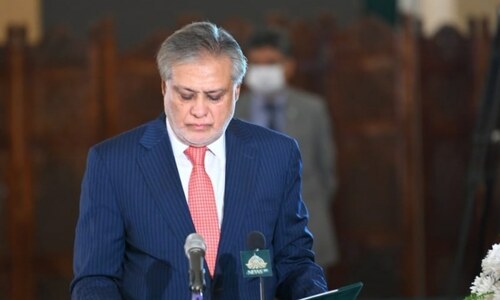
The value of the rupee has depreciated artificially, which is a big problem, Minister for Finance and Revenue Ishaq Dar told journalists just before taking oath as a senator.
His point of view is shared by a substantial segment of the business community and leading analysts. Arif Habib, who has stakes in a diversified field of economic activities, agrees. In fact, he believes that the biggest challenge facing Pakistan is the stability of the rupee.
The problem of the rupee’s stability has become more serious as the expectation that the exchange rate would stabilise after the resumption of the International Monetary Fund (IMF) programme and the release of over $1 billion tranche proved misplaced. This was owing to the anticipated increase in imports of food items and cotton because of crops destroyed by the floods and declining forex reserves built solely by foreign debts.
With the dollar getting stronger against all hard currencies and Pakistan not having enough foreign exchange for defending the rupee against speculative trading, the issue of rupee stability has become more complex.
Maybe his strong-arm tactics and persuasion skills will be more successful in the battle for taming inflation and the runaway rupee
Critics state Dar to be an ‘interventionist’, but he denies it as a ‘massive lie.’
But he is stated to have developed skills with a mix of persuasion and strong-arm tactics to manage the banks and currency dealers and has also built clout among market players. That is believed to be the major reason the rupee has been gaining strength since Dar arrived in Pakistan from London.
Critics also accuse Dar of artificially strengthening the rupee during his previous finance minister tenure, which resulted in the current account crisis. Yet he succeeded in getting more than usual waivers for the deviations from IMF targets and benchmarks set then in the stability programme.
Dar has been tasked by his party supremo Nawaz Sharif to control the dollar rate and bring down inflation. To curb speculative activity in the forex market, the finance minister may get a helping hand from the present State Bank of Pakistan (SBP) Governor Jamil Ahmed. The latter is reputed to be a seasoned central banker with no political link and institutional support. He is the second central banker who is risen from the ranks to become the SBP governor. The first one was I.A. Hanafi.
Talking about his party’s performance during the 2013-17 tenure, Dar recalled that the interest rate was lowest, growth was highest in decades, and the rupee was stable. He says we will try to get in that direction and put the economy on track.
Dar has assumed office at a time when the country faces deep challenges, but he can look forward to a possible breather by the IMF. The Fund has agreed to Pakistan’s request to ease some key conditions linked to Extended Fund Facility Programme.
IMF’s managing director assured Miftah Ismail that the Fund might relax of some key areas of the programme in the wake of the havoc caused by the super floods. The relaxations would be subject to the approval of the IMF executive board of directors.
These relaxations are reported to include frontloading the remaining tranches by increasing the upcoming $1.1bn tranche due within a few weeks, a three-month freeze on existing taxation on petroleum products, fuel cost adjustments in electricity tariff, and a relaxation in the current account and fiscal deficit targets to create room for cotton, wheat and rice imports.
The rupee value has indeed drifted far away from its purchasing power parity against the dollar, which should rationally determine a country’s exchange rate. Moreover, the links of the local currency with the Real Effective Exchange Rate have weakened owing to a widening mismatch between dollar earnings and spending and speculative currency trading.
There is a growing realisation among leading domestic and international economists, officials of the Ministry of Finance and some think tanks that tight monetary policy will not reduce inflation because it is primarily driven by the supply side and not the demand side. Floods have also disrupted the supply chain.
Despite the economic slowdown and 10 per cent super tax on 15 specified sectors with earnings of more than Rs300m in the tax year 2022, top-performing listed companies’ net profits posted a cumulative growth of 22pc to reach Rs1 trillion.
The depreciating exchange rate has not discouraged imports funded by surging unsustainable debts, as evident from the imposition of regulatory duties and administrative measures being taken by the SBP to curb imports.
While these temporary administrative measures to check the outflow of dollars are helping somewhat to contain the current account deficit, it is happening in an economy that is slowing down. The latest official estimate puts the GDP growth rate at 2pc, down from the budgeted 5pc, for this fiscal year owing to torrential rains and a return to the IMF stability programme. The balance of payments remains serious.
Under the present framework of policies whose foundations were laid decades ago, efforts to achieve macroeconomic stability slow down the economy and, in turn, even a brief span of moderately high growth results in macroeconomic imbalances.
The temporary positive impact of a falling rupee in raising exports is wiped out by the multiple negative fallouts on the domestic economy. The adverse terms of trade with costlier imports and cheaper exports result in capital outflows in a country starved of capital.
More goods are sold to earn fewer dollars and more greenbacks are required to import the same quantity of goods. It impacts adversely on the trade balance and capital accumulation is stifled. The rupee cost of servicing foreign debts is a major cause of fiscal deficit.
Even exporters say that the continuing exchange rate depreciation raises the cost of industrial inputs and triggers cost-push inflation, making exports of goods uncompetitive. The worst affected are the poor and vulnerable. And inflation has become a major source of political stability.
Investment needs to be stepped up to stimulate production-led economic growth by keeping the rupee and interest rate relatively stable while gradually reducing imports to sustainable levels and systemically boosting exports.
Published in Dawn, The Business and Finance Weekly, October 3rd, 2022