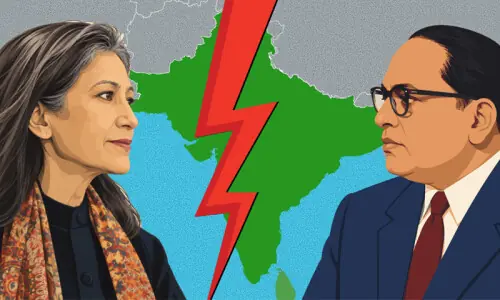
The gallery ArtChowk recently hosted an award-winning virtual reality (VR) docudrama, ‘Child of Empire’, as well as a venture by Project Dastaan, a three-part animated series titled ‘Lost Migration’, in which the forgotten and lost stories of the Partition of India and Pakistan are narrated.
Project Dastaan is an initiative that focuses on real-life stories emerging from the migration that took place during Partition.
It’s impossible to put into words the haunting experience that Project Dastaan has created in ‘Child of Empire’. It’s not only an emotionally immersive experience but one that stimulates the senses as if one were present during the Partition of the Indian Subcontinent. What makes ‘Child of Empire’ special is that two of the stories in the film come from very personal narratives that emerged from the creator’s own family. Sparsh Ahuja, co-founder of Project Dastaan, included both of his grandfathers’ stories, recreating conversations he had with each of them, verbatim.

Out of the many, one particular scene that struck me was of his dada’s [paternal grandfather’s] story. In the VR experience, we see a train travels from Dera Ghazi Khan to Delhi. Dada is impatient. We don’t know why. You hear a disquiet of voices — one of a silent kind. It’s too silent. Suddenly all you see are colours: red, black and red. A frenzy breaks out and you discover most of the train no longer exists. They have been freshly butchered, as if they were just meat.
A virtual reality and an animation exhibition brilliantly bring to life the wounds of our historical past inflicted during the Partition in 1947
Then, a figure slowly creeps right in front of you, levitating above a seat. It is the Hindu god Krishna. The cries and screams disappear. There is quiet on this train, once again. Sparsh’s dada swore he saw Krishna on the train that day. Interestingly, it was later discovered that a Gopinath murti [idol] was smuggled on a train that also travelled from D. G. Khan to Delhi.
Was it the same murti Sparsh’s grandfather saw? We don’t know but, once immersed in the VR experience, you would think so. Sparsh expresses how he was initially nervous to have his grandfather experience the train scene as he worried it might re-traumatise him. His response, after watching the clip was, “There weren’t enough dead bodies.”

This chilling experience was carefully curated as it took up to two years to collect the oral stories of the survivors and witnesses. The purpose of the film is an easy introduction to the 1947 Partition, with an emphasis on the Hindu-Muslim violence that broke out during the time.
However, the takeaway of the film is the numerous accounts that would narrate how friends, family, strangers from the opposing, ‘enemy’ faith would help one another out like they were their own.
Another element from the film worth mentioning is how the two protagonists of the docudrama play Moksha Patam — the original and ancient Indian version of the board game Snakes and Ladders — over a cup of chai. The game only made its way to Britain after the British colonised India.
Whether it’s the horrifying train scene, the bronze cups that the protagonists are drinking chai in, the animated shorts that give light to women and the Chettiar diaspora (shown as a part of the ‘Lost Migration’ series), or Faiz Ahmed Faiz’s poem Subh-e-Azadi — beautifully turned into a theme song by Amira Gill and Vasundhara Gupta — this is a refreshing and unromanticised retelling of the Partition that I feel lucky to have experienced.
For those who missed the exhibition, ‘Child of Empire’ and ‘Lost Migration’ will be permanently housed in the National History Museum (NHM) in Lahore.
‘Child of Empire’ and ‘Lost Migration’ was hosted by the Citizens Archive of Pakistan (CAP) and displayed at ArtChowk The Gallery from December 6-24, 2022
The writer is a Karachi-based poet, writer and oral historian.
She may be reached @zehrajabeenshah
Published in Dawn, EOS, January 1st, 2023