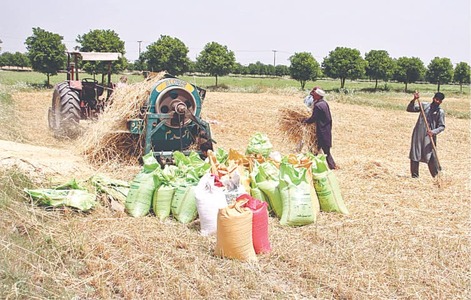
The recent deaths of collectors of subsidised flour bags and the wheat deliveries protected by armed guards prove the country’s unrest. This poses a huge question for economists, analysts and policymakers regarding extensive subsidies on wheat and other crops when they create such a crisis.
Khalid Mahmood Khokhar, president of Pakistan Kissan Ittehad, in his press conference last week, demanded the government to declare an “agriculture emergency”. This clearly indicates that such support prices, subsidies and export promotion schemes for wheat have never worked in the country.
Historically, developed countries give more farm subsidies as compared to developing countries. But after the Subsidies and Countervailing Measures (SCM) Agreement and Agreement on Agriculture by World Trade Organisation, the level of applied export subsidies has regularly decreased from $3.8 billion in 2003 to less than $100 million in 2019. Even the most developed and agrarian countries like Australia, Switzerland, the EU and the United States are following suit.
In our case, it is converse since we declared in the trade policy review mechanism Pakistan of 1994 under the General Agreement on Tariffs and Trade that “according to the authorities, no direct export subsidies are made available in Pakistan”.
The sluggishness of most subsidy-sponsoring industries shows that if the country continues incentivising non-marginal goods instead of marginal goods, these inducements will never enhance the economy’s welfare
Economists debate over the usefulness and adverse effects of subsidies in general and export subsidies in particular. However, advocates give arguments like infant industry protection, externality and imperfect competition etc.
The history of EU agricultural subsidies shows that about €10 billion annually (equivalent to about €17bn euros today) were allocated as export subsidies till the late 1980s. Despite the huge allocation of funds, EU farmers kept on complaining.
The SCM Agreement in the 1990s tried to call off export subsidies. Then, at the 10th Ministerial Conference (2015) in Nairobi by the World Trade Organisation, the developed countries agreed to eliminate such export subsidies immediately, while members from developing countries were expected to eliminate their export subsidy entitlements by the end of 2018. As a result, the EU abolished export subsidies, and the US abolished export credits.
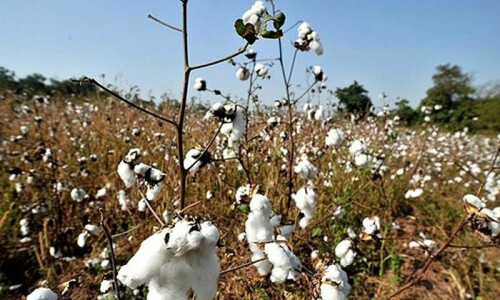
On the contrary, in the last two decades, emerging economies started injecting funds into their economies as export subsidies. These countries include China (cotton), India (sugar), Vietnam and Thailand (rice). Pakistan is no exception; an announcement by Finance Minister Ishaq Dar of Rs100bn for the energy sector to boost the textile industry in October 2022 is an example of it. Similarly, Bangladesh is also following the same path of export subsidies.
Interestingly, advocates of these incentives connect the ready-made garments export growth in Bangladesh with these subsidies. But in reality, other factors initiated the sector’s development, including duty-free market accesses and supportive exchange rate policies. In non-ready-made garment sectors, subsidies failed to create any impact.
But the good thing about the Bangladeshi economy is they learn from their mistakes and have started diversification of exports to promote it through subsidies. In the last year, the addition of four categories: tea, bicycle and parts, steel products, and cement sheets amounted to four per cent of exports, which is proof of that.
On the other hand, Pakistan’s trade liberalisation mechanism is very thin and merely about escaping (un)fair global competitiveness. To do so, on the one hand, fiscal leakages occur for extensive subsidies, and on the other hand, anti-dumping duties are imposed in the name of local industry protectionism.
For example, in February 2022, the National Tariff Commission (NTC) imposed duties in the range of 6.2pc-17.3pc on imported and dumped steel products from Taipei, the European Union, South Korea, and Vietnam. In 2018, the NTC imposed anti-dumping duty on Chinese and South African-origin colour-coated steel coils and sheets in the range of 5.36pc-14.24pc.
The sluggishness of most of the subsidy-sponsoring industries in Pakistan shows that if the country continues subsidising non-marginal goods instead of marginal goods, these incentives will never enhance the welfare of the economy. Export and subsidy diversification, as well as the review of subsidy schemes, is a much-needed step for the dying economy of Pakistan.
The writer is currently a PhD Scholar at the Pakistan Institute of Development Economics, Islamabad. Previously, she served as a researcher in the Finance Division
Published in Dawn, The Business and Finance Weekly, February 6th, 2023