From terrorism to handshake with Indian FM: Key takeaways from Bilawal’s interview in Goa


On the second day of Foreign Minister Bilawal Bhutto-Zardari’s closely watched trip to India — the first time a top Pakistani diplomat has visited the country in 12 years — there was fevered speculation about whether he would speak to the Indian media.
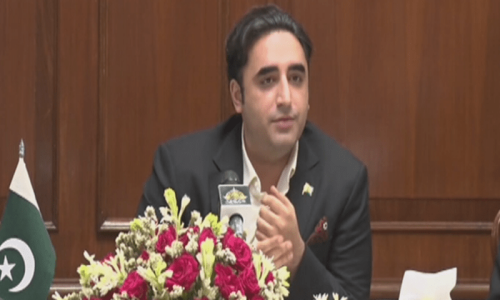
On Friday night, Bilawal gave an interview to Indian news channel India Today, speaking to anchorperson Rajdeep Sardesai, one of India’s most animated and well-known television presenters.
In the highly anticipated interview, which the anchorperson prefaced with the Indian refrain “terror cannot coexist with talks,” Bilawal calmly and coolly explained Pakistan’s position on the various issues plaguing the frigid Pakistan-India relationship, while Sardesai repeatedly — and often combatively — steered the conversation towards terrorism.
Here are key takeaways from his interview.
‘Pakistan dealing with militancy for itself, not India’
During the interview, anchorperson Rajdeep Sardesai mentioned that India’s position on engaging with Pakistan had been that “terror and talks can’t go together”.
To that, Bilawal said Pakistan was addressing terrorism because it wanted an end to it and not just because India or the Indian government said so.
“As far as India’s position is concerned, terrorism is nothing new. It’s an old challenge. Despite having to face this challenge, we have had on-and-off talks. But I don’t know how consistent India’s position is,” he added, assuring that “Pakistan and I are wholly committed to combating this menace (terrorism)”.
At a later point, he reiterated that Pakistan was dealing with terrorism for itself and not India.
Addressing concerns is a two-way street
The foreign minister also made it clear that while Pakistan was willing to address India’s concerns regarding terrorism, it expected the same from New Delhi.
“We are ready and willing to engage and address India’s concerns but India will have to address our concerns too,” he said.
He added, “India will have to explain what Kulbushan Jadhav — who is an Indian spy sentenced to death by Pakistan for his involvement in subversive activities, not a nonstate actor but a navy commander — was doing in Pakistan carrying out terrorist attacks on Pakistani soil.
“Does that not come under cross-border terrorism?”
The foreign minister said this was just one incident of such a nature, mentioning then bombing of Samjhauta Express.
But India, he said, refused to accept that Pakistan had legitimate concerns.
How to engage on counter-terrorism efforts?
In another instance in the interview, Bilawal said he was not denying the legitimacy of India’s concerns, “but all I’m saying is the way you’re trying to address and resolve this concern is not productive”.
Sharing his views on the narrative on terrorism in India, he added, “This wolf whistling around the word terrorism, which is ultimately an Islamophobic wolf whistle, is not only to whip up the Hindu sentiment in India but also to browbeat Pakistan — which certainly might be a good electioneering strategy but not an effective counter-terrorism strategy.”
Bilawal said that with better coordination, not just between India and Pakistan but also among the international community, “we can achieve far more than we have today”.
Later on in the interview, he said the issue of terrorism would never be resolved if it was turned into domestic and geopolitical point scoring.
What’s hampering progress of Mumbai attacks trial?
He also spoke at length about the trial of 2008 Mumbai attacks, in which 166 people were killed in a three-day rampage through India’s financial capital.
“There is a Mumbai trial ongoing within Pakistan. The reason that the trial has not progressed is because India is refusing to send witnesses,” he explained.
Bilawal added, “We have a very similar legal system in Pakistan and India. You can provide as many pieces of paper as you like but as your legal system works, so does mine. Along with the pieces of paper, you will have to provide witnesses for the case to progress.”
He said the case could not conclude without India’s cooperation.
Whose words are ‘butcher of Gujarat’?
When Sardesai asked Bilawal why had he used the words “butcher of Gujarat” for Indian Prime Minister Narendra Modi during a UN briefing in December last year, the foreign minister said he was quoting Indian citizens.
The handshake
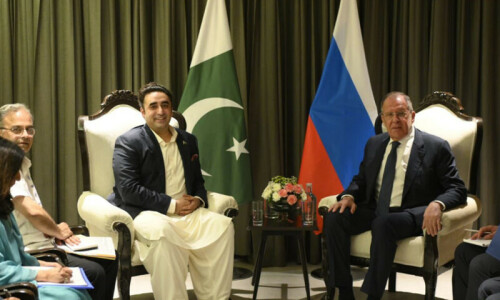
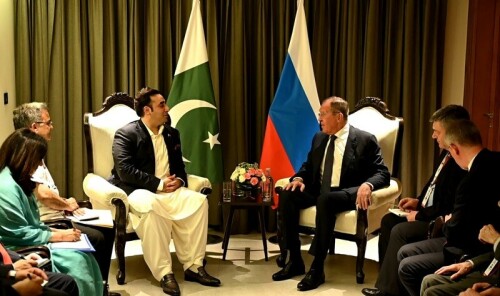
Asked whether he and his Indian counterpart shook hands, the foreign minister replied: “Yes of course we shook hands. In all our unofficial engagements, we always shake hands”.
In Goa earlier, Indian Minister of External Affairs S. Jaishankar and Bilawal posed for a protocol picture but didn’t shake hands, which made headlines in India.