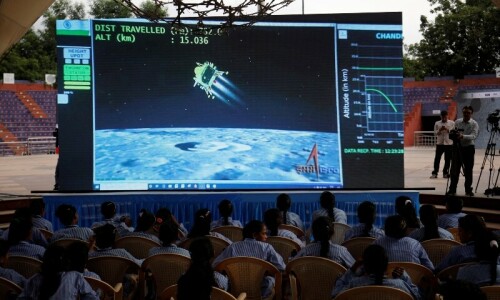
INDIA’S successful Chandrayaan-3 mission is indeed historic, as the craft became the first to land near the south pole of the moon. Moreover, with this feat, India joins a select club of nations — including the US, Russia and China — that have achieved controlled landings on the lunar surface.
While there is much wrong with modern India, especially with the Hindu majoritarian government’s repressive tendencies, this particular feat deserves appreciation as our eastern neighbour achieved on a lesser budget what richer nations accomplished by spending larger sums.
Nearly a decade ago, the Indians also successfully launched the Mangalyaan observer mission to Mars, while success was achieved in the latest moon mission after Chandrayaan-2 failed in 2019.
Perhaps the key to the success of India’s space programme, apart from sustained state support, is the quality and dedication of its engineers and scientists who helped make these difficult missions possible.
Comparisons are indeed odious, but there may be plenty for Pakistan to learn from India’s space success. Pakistan’s space programme was launched before India’s and managed modest success, such as launching a rocket in the early 1960s under the watch of luminaries such as Dr Abdus Salam.
In 1990, we managed to put a satellite, Badr-1, into space. These missions were accomplished with American and later Chinese help. However, in the decades since, our national space body, Suparco, has not achieved any stellar success.
There are various reasons for our space programme remaining earth-bound. Among these include the fact that, particularly in the recent past, Pakistan’s space agency has been helmed by retired military men, not experts in the field.
Also, much has been written about our education system, and the fact that it is not producing the required manpower to give Pakistan a qualitative edge in science and technology.
Sadly, we have become consumers of science and technology, and not producers of knowledge. Moreover, we lose our best minds to brain drain as bright youngsters opt for greener pastures due to stifling bureaucracy and lack of merit and opportunities at home.
While Pakistan cannot afford to pursue vanity projects — a former minister had boasted about putting a person in space — a functional space programme is important for defence and civilian needs.
Perhaps we can learn from India in this respect by revamping Suparco and encouraging our brightest to innovate and reach for the stars.
Published in Dawn, August 25th, 2023