India becomes first nation to land spacecraft near Moon’s south pole


India on Wednesday became the first nation to land a craft near the Moon’s south pole, a historic triumph for the world’s most populous nation and its ambitious, cut-price space programme.
The unmanned Chandrayaan-3, which means “Mooncraft” in Sanskrit, touched down at 6:04pm India time (1234 GMT) as mission control technicians cheered wildly and embraced their colleagues.
Its landing comes days after a Russian probe crashed in the same region and four years since the previous Indian attempt failed at the last moment.
Prime Minister Narendra Modi smiled broadly and waved an Indian flag on a live broadcast to announce the mission’s success as a triumph that extended beyond his country’s borders.
“On this joyous occasion I would like to address the people of the world,” said Modi from the sidelines of the BRICS diplomatic summit in South Africa.
“India’s successful moon mission is not just India’s alone,” he added.
“This success belongs to all of humanity.”
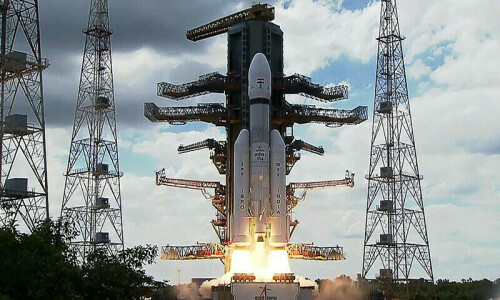
The Chandrayaan-3 mission has captivated public attention since launching nearly six weeks ago in front of thousands of cheering spectators.
Politicians staged Hindu prayer rituals to wish for the mission’s success and schoolchildren followed the final moments of the landing from live broadcasts in classrooms.
Chandrayaan-3 took much longer to reach the Moon than the Apollo missions in the 1960s and 1970s, which arrived in a matter of days.
India used rockets much less powerful than the ones the United States used back then, meaning the probe had to orbit the Earth several times to gain speed before embarking on its month-long journey.
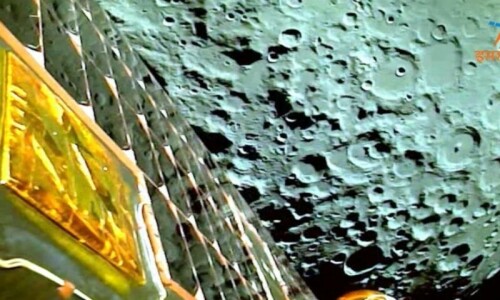
The lander, Vikram, which means “valour” in Sanskrit, detached from its propulsion module last week and has been sending images of the Moon’s surface since entering lunar orbit on August 5.
Now that Vikram has landed, a solar-powered rover will explore the surface and transmit data to Earth over its two-week lifespan.
Ambitious programme
India is closing in on milestones set by global space powers such as the United States and Russia, conducting many of its missions at much lower price tags.
The South Asian nation has a comparatively low-budget space programme, but one that has grown considerably in size and momentum since it first sent a probe to orbit the Moon in 2008.
The latest mission has a cost of $74.6 million — far lower than those of other countries, and a testament to India’s frugal space engineering.
Experts say India can keep costs low by copying and adapting existing technology, and thanks to an abundance of highly skilled engineers who earn a fraction of their foreign counterparts’ wages.
In 2014, India became the first Asian nation to put a craft into orbit around Mars and is slated to launch a three-day crewed mission into Earth’s orbit by next year.
Wednesday’s landing had been eagerly awaited by the Indian Space Research Organisation (ISRO) after the frustrating failure of its previous mission at the last hurdle in 2019.
Back then, mission control lost contact with the Chandrayaan-2 lunar module moments before its slated landing.
‘Very, very important’
Former ISRO chief K. Sivan told AFP that India’s efforts to explore the relatively unmapped lunar south pole would make a “very, very important” contribution to scientific knowledge.
Only Russia, the United States and China have previously achieved controlled landings on the Moon.
Russia launched a lunar probe in August — its first in nearly half a century.
If successful, it would have beaten Chandrayaan-3 by a matter of days to become the first mission from any nation to make a controlled landing around the south pole.
But Luna-25 crashed on Saturday after an unspecified incident as it prepared to descend.